

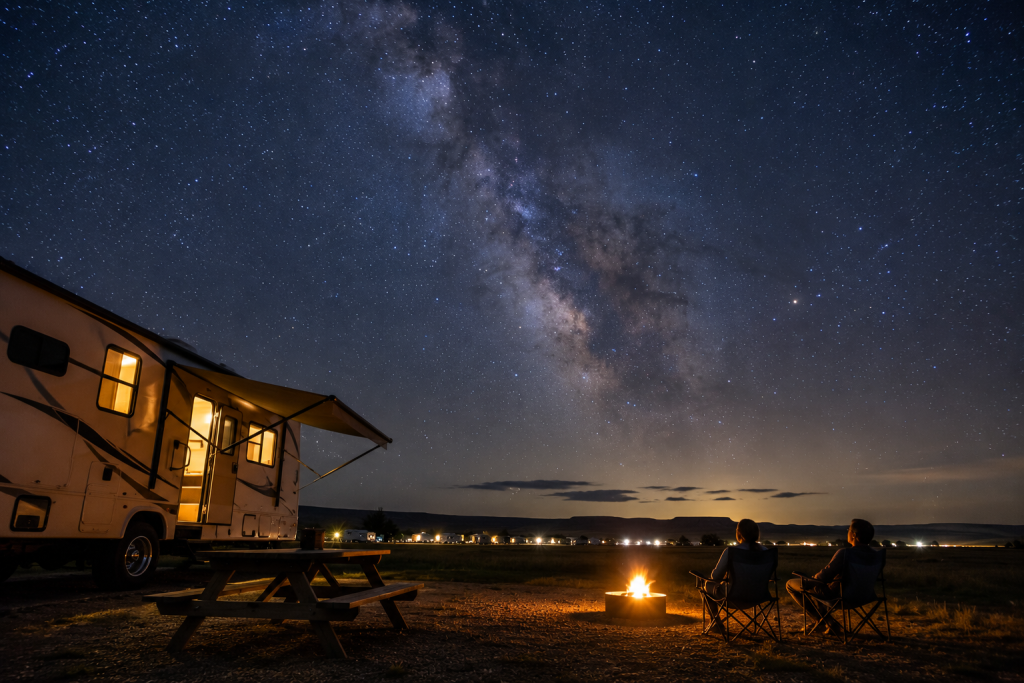
Watford City sits in one of the darkest, clearest stretches of night sky remaining in the continental United States, and July gives you the added advantage of warm nights that make actually staying outside past dark comfortable rather than a cold-weather endurance test. The Milky Way isn’t a faint smudge here — on a clear, moonless night it arches overhead as a genuinely bright band, visible without a telescope, without light pollution, without needing to explain to anyone what they’re looking at.
Most Americans have never actually seen the Milky Way. Light pollution maps consistently show that a majority of the US population lives under skies bright enough to wash it out entirely. Western North Dakota, and specifically the Bakken region around Watford City and Theodore Roosevelt National Park, is one of the genuine exceptions — a place where the night sky still looks the way it looked to everyone before electric light existed. July adds the comfort factor that makes actually experiencing this practical rather than theoretical.
Why the Bakken Sky Is So Dark
The darkness of the North Dakota Badlands sky comes down to a combination of remoteness and low regional population density. Theodore Roosevelt National Park sits more than 30 miles from any large city, and the terrain itself — badlands topography with buttes and coulees that block sightlines to whatever distant light sources do exist — creates natural barriers against light pollution that flat, open terrain elsewhere doesn’t provide. Even the nearby towns of Watford City, Medora, and Belfield contribute minimal sky glow relative to their populations, because the region’s overall population density is so low.
Theodore Roosevelt National Park is rated Bortle Class 3 on the Bortle dark-sky scale — a scale that runs from 1 (the darkest possible sky) to 9 (inner-city sky). Class 3 represents genuinely dark rural sky conditions where the Milky Way displays structure and detail, where the zodiacal light is visible under good conditions, and where naked-eye limiting magnitude reaches into the 6th or 7th magnitude range — meaning you can see stars roughly four times fainter than what’s visible from a typical suburban backyard.
“People who grew up in cities or suburbs sometimes don’t believe what they’re looking at the first time they see a truly dark sky. The Milky Way isn’t a hint of brightness you have to squint for — it’s a structured, textured band with visible dust lanes, bright star clusters, and genuine three-dimensional depth. That reaction, the first time someone really sees it, is worth the drive out to the North Unit by itself.”
Where to Go: The North Unit’s Dark Sky Overlooks
Theodore Roosevelt National Park’s North Unit, about 14 miles south of Watford City, is the area’s premier stargazing destination, and specific spots within the unit are known among regular visitors and astrophotographers for their combination of accessibility and sky quality.
Oxbow Overlook
Oxbow Overlook, at the terminus of the North Unit’s 14-mile scenic drive, is both the park’s signature daytime viewpoint and one of its best stargazing locations. The overlook’s elevation and open sky exposure give an unobstructed view across a huge arc of sky, and its distance from the park entrance means it’s about as far from any residual light sources as the North Unit gets. Historically, this has been one of the telescope setup locations for the park’s organized stargazing events.
Beef Corral Bottom
Beef Corral Bottom, also in the North Unit, is a wide valley overlook that’s specifically noted for being both accessible (no hike required — park and set up) and secluded, with a historic CCC-era shelter and views over the Little Missouri River. Its combination of easy access and genuine dark-sky isolation makes it a favorite among astrophotographers who want to combine a landscape foreground with the night sky rather than shooting sky-only images.
Cottonwood Campground (South Unit)
For visitors who venture down to the South Unit near Medora, Cottonwood Campground has functioned as an official stargazing and presentation location during the park’s organized astronomy events, giving a developed camping base directly at a known good-sky location rather than requiring a separate stargazing drive after settling into camp.
The North Dakota Badlands Star Party
Theodore Roosevelt National Park hosts an annual stargazing event — the North Dakota Badlands Star Party — typically held in the North Unit and organized in partnership with the Northern Sky Astronomical Society of Grand Forks. The event is generally timed around a new moon for maximum sky darkness, with telescopes set up at dusk for public constellation tours and, during daytime programming, solar telescopes for safely viewing the sun. This is the single best opportunity to experience the North Unit’s sky with knowledgeable astronomers present to help identify what you’re looking at — check nps.gov/thro for current-year dates, as the specific weekend varies annually and is weather-dependent for full enjoyment.
What You Can Actually See in July
July’s night sky from Watford City’s latitude offers a specific seasonal lineup worth knowing before you head out. The Milky Way’s galactic core — the brightest, most visually dense section of our galaxy — is well-positioned in the southern sky during summer evenings, making July and August the best months of the year for Milky Way photography and naked-eye viewing at this latitude. Saturn and Jupiter are typically well-placed for viewing during summer months, visible as bright, non-twinkling points of light even before you point a telescope at them — check a current sky chart or app for their specific position during your visit, as planetary positions shift year to year.
The Perseid meteor shower, while peaking in mid-August, begins producing an elevated meteor rate in the final days of July, giving early viewers a preview of the display before the official peak. Under Bortle Class 3 skies, meteor rates that would be invisible under suburban light pollution become genuinely countable, and a clear late-July or early-August night at a North Unit overlook is one of the better meteor-watching opportunities available in the country.
The aurora borealis is also a possibility at this latitude, particularly during periods of elevated solar activity — Watford City’s approximately 47.8°N latitude puts it within range of aurora displays during moderate-to-strong geomagnetic storms, appearing as green, pink, or violet light on the northern horizon. Aurora forecasting apps and NOAA’s Space Weather Prediction Center (swpc.noaa.gov) give advance notice of elevated aurora probability if this is a specific interest.
Timing Your Stargazing Night in July
July stargazing at Watford City’s latitude requires patience with the clock — the Northern Plains’ extended summer daylight means true astronomical darkness arrives later than most stargazers expect. Sunset in early July runs around 9:28 to 9:32 p.m., with civil twilight (still too bright for good stargazing) extending to approximately 10 p.m. Astronomical twilight — the point at which the sky reaches full darkness — doesn’t arrive until roughly 11:15 to 11:30 p.m. in early July.
This means serious stargazing at this latitude in early-to-mid July is a late-night activity by necessity, not preference. Planning a stargazing outing means either committing to a genuinely late night (arriving at your viewing spot around 10:30 to 11 p.m. and staying until you’ve seen what you came for) or waiting until later in July and into August, when the daylight window shortens and full darkness arrives earlier in the evening.
Watford City area stargazing — quick reference: Sky quality: Theodore Roosevelt National Park rated Bortle Class 3 — genuinely dark rural sky, structured Milky Way visible to the naked eye. Best spots: Oxbow Overlook (North Unit, 14 mi south of Watford City) and Beef Corral Bottom (North Unit, historic CCC shelter, no hike required). Cottonwood Campground in the South Unit near Medora for a developed camping base. Timing in July: sunset ~9:28-9:32 p.m. Civil twilight ends ~10 p.m. True astronomical darkness ~11:15-11:30 p.m. Plan for a late night. Annual event: North Dakota Badlands Star Party, hosted with the Northern Sky Astronomical Society of Grand Forks, timed near new moon. Check nps.gov/thro for current dates. What to see: Milky Way galactic core (best July-August), Saturn/Jupiter (check current position), early Perseid activity in late July, possible aurora at 47.8°N during geomagnetic storms (check swpc.noaa.gov). Etiquette: use red lights only for equipment setup to preserve night vision for yourself and others.
For oilfield workers and long-term Bakken residents who want to build stargazing into a regular off-rotation routine, the oilfield worker housing at Watford City RV Park covers the base-camp logistics for extended Bakken stays. Guests on monthly rates who want the full summer sky season can check the monthly RV sites in Watford City. Visitors approaching from the Stanley, ND corridor to the northeast can check the RV park near Stanley, ND page. And for planning any Watford City summer stay with North Unit stargazing in mind, Watford City RV Park is the starting point.
Frequently Asked Questions
Is Theodore Roosevelt National Park good for stargazing?
Yes — Theodore Roosevelt National Park is rated Bortle Class 3 on the Bortle dark-sky scale, representing genuinely dark rural sky conditions among the best available in the continental United States. The park sits more than 30 miles from any large city, and the badlands topography itself blocks sightlines to what limited artificial light sources exist in the surrounding region. Under clear, moonless conditions, the Milky Way is visible to the naked eye with visible structure and detail — dust lanes, bright star clusters, and genuine depth — rather than the faint smudge visible under moderate light pollution. The North Unit, approximately 14 miles south of Watford City, and the South Unit near Medora both offer excellent stargazing conditions, with specific overlooks like Oxbow Overlook and Beef Corral Bottom known among regular visitors for combining accessibility with sky quality.
What time does it get dark enough to stargaze in Watford City in July?
Watford City sits at approximately 47.8°N latitude, which produces extended summer daylight and a correspondingly late arrival of true darkness in July. Sunset in early July occurs around 9:28 to 9:32 p.m., but civil twilight — during which the sky is still too bright for quality stargazing — extends until approximately 10 p.m. Astronomical twilight, the point at which the sky reaches genuine darkness suitable for viewing faint objects and the full Milky Way, doesn’t arrive until roughly 11:15 to 11:30 p.m. in early July. This means serious July stargazing at this latitude requires planning for a late night — arriving at a viewing location around 10:30 to 11 p.m. gives the best combination of comfortable timing and genuine sky darkness.
Where is the best place to stargaze near Watford City?
The North Unit of Theodore Roosevelt National Park, approximately 14 miles south of Watford City on US-85, offers the area’s best combination of accessible dark-sky viewing. Oxbow Overlook, at the end of the 14-mile scenic drive, provides an open, elevated view across a wide arc of sky and has historically served as a telescope setup location for the park’s organized stargazing events. Beef Corral Bottom, also in the North Unit, is a wide valley overlook accessible without a hike, featuring a historic CCC-era shelter and views over the Little Missouri River — a favorite among astrophotographers for combining a landscape foreground with the night sky. Both locations benefit from the North Unit’s remoteness and the badlands terrain’s natural blocking of any residual light sources from surrounding towns.
What is the North Dakota Badlands Star Party?
The North Dakota Badlands Star Party is an annual stargazing event hosted at Theodore Roosevelt National Park, typically in the North Unit, organized in partnership with the Northern Sky Astronomical Society of Grand Forks. The event is generally scheduled around a new moon for maximum sky darkness and features telescopes set up at dusk for public constellation tours, along with solar telescope viewing during daytime hours. Park rangers and visiting astronomers provide guided information about what’s visible, making it an excellent opportunity for visitors without their own equipment or astronomy knowledge to experience the park’s dark skies with expert guidance. Current year dates and any registration requirements are posted at nps.gov/thro — the specific weekend varies annually.
Can you see the Milky Way from Watford City, North Dakota?
Yes, particularly at Theodore Roosevelt National Park’s North Unit, approximately 14 miles south of Watford City. Under clear, moonless conditions, the Milky Way’s galactic core is visible to the naked eye as a bright, structured band arching across the sky, with visible detail including dust lanes and bright star clusters — a dramatically more vivid view than what’s visible from areas with even moderate light pollution. July and August are the best months for Milky Way viewing at this latitude, as the galactic core is well-positioned in the southern sky during summer evening hours. Viewing quality depends on moon phase (new moon or crescent moon conditions are best) and requires waiting until true astronomical darkness, which in July doesn’t arrive until approximately 11:15 to 11:30 p.m. due to the region’s extended summer daylight.
Can you see the Northern Lights from Watford City, ND?
Yes, under the right solar activity conditions. Watford City’s latitude of approximately 47.8°N puts it within range of aurora borealis displays during moderate-to-strong geomagnetic storms, appearing as green, pink, or violet light on the northern horizon. Aurora visibility at this latitude is not guaranteed on any given night — it depends on solar activity and geomagnetic storm strength, which varies significantly. Checking aurora forecasting resources such as NOAA’s Space Weather Prediction Center (swpc.noaa.gov) or aurora forecast apps in advance gives notice of elevated aurora probability. When conditions align, the combination of Theodore Roosevelt National Park’s dark skies and an active aurora display produces an exceptional viewing experience that’s genuinely rare at more southerly latitudes.