
The Bakken in July surprises people who haven’t experienced it. The image most people carry of North Dakota is cold and gray — which is fair for nine months of the year. July is different. Watford City in midsummer runs upper 80s to low 90s°F, with direct sun on the open prairie terrain that makes the felt temperature higher. And the wind, which is there in every season, does something interesting in July: on some days it helps, and on others it works against every shade and cooling strategy you’ve got.
The Northern Plains summer heat management equation is different from South Texas or the Hill Country in one key way: you’ve got 16 hours of daylight and meaningful wind most days, which gives you both a resource and a variable to manage simultaneously. This guide covers the specific practical tools — RV air conditioning management, awning deployment in a windy environment, and shade strategies for the Northern Plains — that make a July stay in the Bakken genuinely comfortable rather than a test of endurance.
Understanding the Bakken July Climate
Watford City sits at approximately 47.8° north latitude, about 650 feet above sea level, in a semi-arid continental climate. July average highs run around 87 to 92°F, with occasional peaks above 95°F during heat events. Overnight lows in the upper 50s to mid-60s°F are a significant advantage over more southerly summer camping destinations — the nights actually cool down to sleeping temperatures that southern RV campers in July can only dream about.
The low humidity is the other critical variable. The Northern Plains is not the Gulf Coast. Relative humidity in July at Watford City is typically in the 30 to 50 percent range, which means evaporative cooling works significantly better than in humid climates. A 90°F day at 35 percent humidity feels considerably more manageable than the same temperature at 85 percent humidity. Sweat evaporates. Shade actually cools. The dry-heat math works in your favor here in a way it doesn’t in Texarkana or McAllen.
The wind is the wild card. Watford City’s open terrain — no significant topography to interrupt the flow — means the prairie wind that blows through much of the year is just as present in July. Average wind speeds in the area run 10 to 15 mph with gusts regularly reaching 25 to 30 mph during afternoon weather development. That wind is your air conditioning when it’s cool and your heat amplifier when it’s hot and blowing from the south. It’s also your awning’s biggest challenge.
RV Air Conditioning in the Bakken: Getting the Most From It
The AC math for July in Watford City is favorable compared to deep-South camping: you’re typically managing 88 to 92°F ambient temperatures rather than 98 to 102°F. But the rooftop AC units on most RVs are rated for conditions that the Bakken July can challenge at peak heat, and how you manage the AC determines whether it’s comfortable all day or barely keeping up by 3 p.m.
Pre-Cooling the Rig in the Morning
The most effective AC management strategy in the Bakken July is pre-cooling the rig before the ambient heat peaks. Open the windows on the opposite side from the morning sun when the air is still cool — typically 6 to 8 a.m. — and let the cool morning air flush the interior to a lower starting temperature. Then close everything up and run the AC starting around 9 a.m. before the interior has had a chance to heat up. An AC unit maintaining a 72°F interior against an 88°F ambient is a fundamentally different task from an AC unit trying to pull a 95°F interior down to 72°F. Starting cool and maintaining is the efficient operating mode.
The 50-Amp Advantage
The Bakken summer is the argument for confirming 50-amp hookup when booking your site. A large Class A or fifth wheel running two AC units simultaneously needs 50-amp service (12,000 watts at 240 volts) to run both at full capacity without circuit management. Running one AC unit on a 30-amp site while the second is unavailable means the side of the rig without AC coverage gets significantly hotter, and the interior temperature stratification that results — cooler at the AC end, warmer toward the bedroom or far end — degrades sleep quality specifically. 50-amp full hookup is the setup that lets both units run freely when the Bakken July does its thing.
Heat Load Reduction
Every heat source inside the rig during the hottest hours compounds the AC load. This is more relevant in a Northern Plains summer because the AC is already working near its comfortable range for the ambient conditions. Avoid running the oven, stovetop, or other high-heat cooking appliances during the peak afternoon hours — cook outdoors in the morning, eat cold or reheated in the afternoon. Minimize LED lighting use in the peak heat window (LED lights do generate heat, though significantly less than incandescent). Close all the window blinds on the sun-facing side; reflective blinds or cellular shades specifically designed for RVs reduce solar heat gain through the windows more effectively than standard fabric blinds.
“The rig that starts the afternoon at 72°F and keeps the AC running ahead of the heat is a different experience from the rig that’s been sitting in the Bakken sun all day while you were at the North Unit and is now 95°F inside. Pre-cooling in the morning is the single most important AC habit.”
Awnings in Bakken Wind: The Most Important Rule
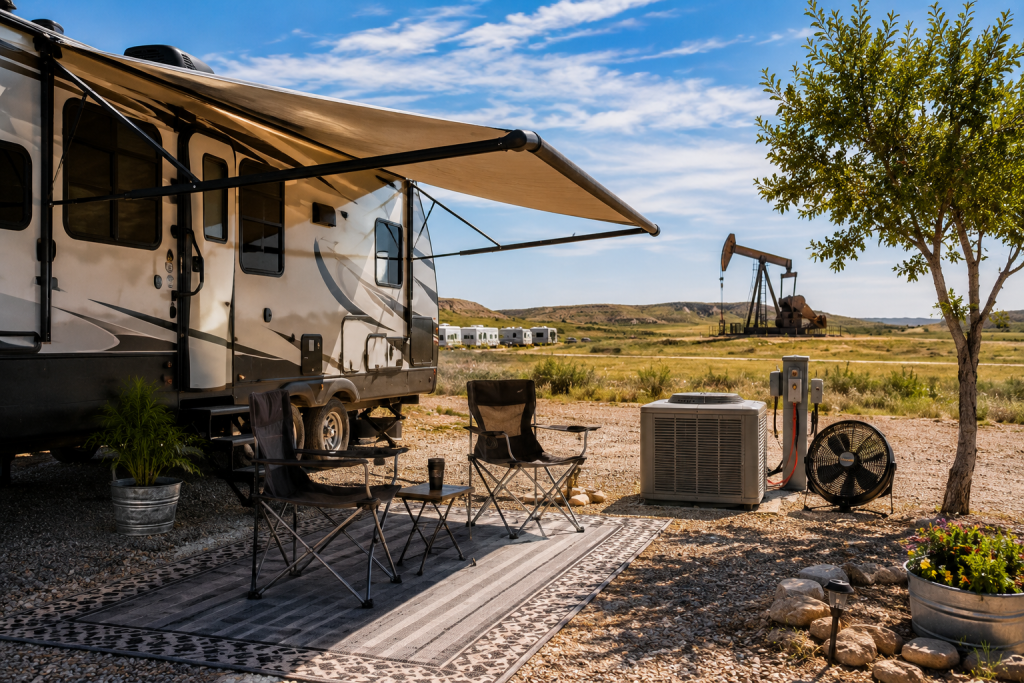
The most expensive lesson that RV campers learn in the Bakken — sometimes the very first week — is leaving the awning out in conditions that the awning can’t handle. RV awnings are shade structures, not wind structures. The standard electric awning found on most modern RVs is rated for approximately 20 mph sustained wind — some models somewhat higher, but 20 mph is the conservative threshold that most manufacturers use in their guidance. Bakken July afternoon gusts regularly reach 25 to 35 mph, and an awning that’s out during one of those gusts becomes either a bent arm problem, a torn fabric problem, or in the worst case, a ripped-off-the-side-of-the-rig problem.
The Awning Weather Protocol
The rule that works: if you’re leaving the campsite for more than 15 minutes, the awning goes in. Full stop. The Bakken weather develops quickly enough on summer afternoons that a morning of mild wind can transition to 30-mph gusts within an hour, and the awning that was fine when you left for a Theodore Roosevelt National Park morning might not be fine when you return. Every awning story that ends in a repair bill starts with “I was only going to be gone for a little while.”
When you’re at the site and using the awning: deploy the awning at a slight downward angle (most electric awning controllers allow this) so wind gets under it rather than pressing it upward, which is the loading direction that damages arms. Use awning tie-down straps anchored to the ground at both arms — these add lateral stability that significantly extends the wind speed the awning can tolerate while deployed. A 20 mph sustained wind with tie-downs is manageable; the same wind without them is not. Watch the sky toward the west and southwest — that’s where the Bakken afternoon weather develops, and a building cloud cell in that direction is the visual cue to start pulling in the awning while you still have an organized option.
Wind Screens and Partial Deployment
If the wind is coming from a consistent direction, partial awning deployment — extending the awning less than full extension — reduces the sail area and lowers the wind load on the arms. A 10-foot extension at half-arm extension takes significantly less wind load than the same awning fully deployed to 14 feet. Wind screens attached to the awning end create a wind break perpendicular to the awning face, but they also increase the total sail area in side-wind conditions. Know which direction your Bakken wind is coming from before deploying the screen — a screen that helps in a south wind can damage the awning in a northwest wind shift.
Shade Strategies Beyond the Awning
The awning provides shade on one side of the rig. The Bakken July sun moves across a sky arc that means no single shade structure covers you all day. Building a complete shade environment at your campsite for a hot July day requires thinking through the full arc from morning to evening.
The 10×10 or 10×20 Canopy
A freestanding portable canopy — the same 10×10 or 10×20 EZ-Up style used at farmers markets and outdoor events — positioned on the sunny side of the outdoor living space gives you shade coverage that you control independently of the awning. The canopy doesn’t extend from the rig, so wind loading is on four independent legs rather than on the rig’s wall. Guy-wire or stake the canopy in Bakken wind. An un-staked canopy in 25 mph gusts becomes a projectile, and a projectile heading toward other rigs in the park is not a neighborly situation. Canopy stakes with deep-reach ground anchors rather than the stub stakes that come in the bag work significantly better in the open soil of a Northern Plains campsite.
Site Orientation and Natural Wind Breaks
Not all sites at a Watford City area RV park are oriented or positioned the same way. When booking, ask about site orientation relative to the typical summer wind direction (typically southwest in Watford City summer afternoons). A site with the rig positioned so the awning side faces east — away from the typical southwest summer wind — means the awning is less frequently challenged by the peak afternoon wind direction. Sites adjacent to any natural wind break (a fence, a row of trees, a utility building) have meaningful shelter from the prairie wind that exposed sites don’t. Asking specifically about wind-sheltered sites at booking is the kind of pre-planning question that pays off across a long stay.
Bakken July RV heat and wind management — practical summary: AC: pre-cool the rig in the morning (open windows 6-8am, close and run AC from 9am). 50-amp hookup runs both units without circuit management. No oven/stovetop during peak afternoon. Reflective window blinds on sun-facing side. Awnings: if leaving for more than 15 minutes, retract the awning. Use tie-down straps anchored at both arms when deployed. Watch the western sky for weather development. Partial deployment reduces wind load in marginal conditions. Portable canopy: 10×10 or 10×20 freestanding canopy staked with deep-reach anchors supplements the awning shade arc. Never leave un-staked in Bakken wind. Site selection: ask for wind-sheltered sites or east-facing awning orientation at booking. Adjacent structures provide meaningful wind break. Temperature context: Watford City July runs 87-92°F with upper 50s-mid 60s overnight. Dry heat (30-50% RH) — evaporative cooling works. Nights cool for sleeping. Better than Gulf coast summer in terms of felt heat.
For oilfield workers and extended-stay Bakken residents who need the full picture on summer site logistics, the oilfield worker housing at Watford City RV Park covers what a long-term summer Bakken stay looks like in practice. Monthly-rate guests who want to dial in their summer campsite setup from the start can check the monthly RV sites in Watford City. Visitors coming from the Tioga corridor to the east can check the RV park near Tioga, ND page. And for booking any Watford City summer stay, Watford City RV Park is the starting point.
Frequently Asked Questions
How hot does it get in Watford City, ND in July?
Watford City in July typically sees daytime highs in the upper 80s to low 90s°F, with average highs around 87 to 92°F and occasional heat events pushing temperatures above 95°F. Overnight lows are significantly more comfortable than southern US camping destinations, dropping to the upper 50s to mid-60s°F — genuine sleeping temperatures rather than the 75-80°F overnight lows that Gulf Coast summer camping produces. Relative humidity in July at this latitude is typically in the 30 to 50 percent range, making the felt temperature more manageable than the same air temperature would feel in a humid climate. The combination of dry heat during the day and cool overnight temperatures makes July in the Bakken more tolerable for RV camping than the raw maximum temperature number might suggest.
How windy is Watford City in July?
Watford City’s open Northern Plains terrain produces consistent wind across all seasons, including July. Average sustained wind speeds in the Watford City area run approximately 10 to 15 mph, with afternoon gusts regularly reaching 25 to 30 mph during weather development periods. Afternoon thunderstorm cells, which develop primarily from the west and southwest during summer, can produce brief gusts above 35 mph during cell passage. The wind direction is predominantly from the south and southwest during July’s warmer days. July wind in the Bakken is a heat management asset when the temperature is reasonable and the wind is cool — and a specific hazard for extended awnings and un-staked canopies when afternoon gusts develop.
Is a 30-amp or 50-amp site better for summer camping in the Bakken?
50-amp service is significantly better for summer Bakken camping in any rig with two air conditioning units or significant electrical load from heating or cooling appliances. A 50-amp site provides 12,000 watts at 240 volts — sufficient to run two rooftop AC units simultaneously at full capacity plus standard appliance load. A 30-amp site provides 3,600 watts at 120 volts, which is adequate for a single AC unit in a smaller rig but limits larger rigs to running one unit at a time with careful load management. In Watford City July conditions where the AC needs to run continuously during peak afternoon hours to maintain comfortable interior temperatures, the ability to run both units without circuit management is a meaningful quality-of-life improvement for larger rigs.
What wind speed is safe for RV awnings?
Most RV electric awnings are rated by their manufacturers for approximately 20 mph sustained wind — some models are rated slightly higher, but 20 mph is the conservative threshold used in most manufacturer guidance. Bakken July afternoon gusts regularly reach 25 to 35 mph, which exceeds the safe operating range for most deployed awnings without additional support. Awning tie-down straps anchored at both arms significantly increase the wind tolerance of a deployed awning by adding lateral stability — an anchored awning handles higher wind loads than an un-anchored one. The practical rule for Bakken camping: if you’re leaving the site for any reason, retract the awning. The cost of an awning repair from unexpected wind damage significantly exceeds the inconvenience of retracting and redeploying it on return.
What are the best shade strategies for an RV site in the Bakken?
The most effective shade strategy for a Bakken RV site in July combines the RV’s awning for one side of the outdoor living space with a freestanding 10×10 or 10×20 portable canopy staked with deep-reach ground anchors for the other angles of sun coverage. Reflective window blinds or cellular shades on the sun-facing side of the rig significantly reduce solar heat gain through the windows — more effective than standard fabric blinds for interior temperature management. Site selection matters: asking for sites with eastern awning orientation (awning faces east, away from the typical southwest afternoon wind) and any natural wind break proximity reduces both sun exposure and awning wind loading. In the morning, opening cross-ventilation windows while the air is cool lowers the rig’s starting interior temperature before the AC takes over at 9 a.m.
What are the best tips for RV camping in summer in North Dakota?
The most impactful practices for comfortable summer RV camping in the Watford City and Bakken area: pre-cool the rig in the early morning before the ambient heat peaks, then close up and run AC from roughly 9 a.m. forward; confirm 50-amp hookup for rigs with two AC units; retract the awning any time you leave the site and always use tie-down straps when deployed; stake all portable shade structures with deep-reach anchors rather than stub stakes; reduce internal heat load by avoiding oven or stovetop cooking during peak afternoon hours; take advantage of the genuinely cool overnight temperatures by opening windows after sunset to let the rig cool naturally, then closing before morning sun angle begins heating the sun-facing side. The cool Bakken nights are a resource that southern summer camping doesn’t provide — using them for natural overnight ventilation reduces the AC’s morning workload significantly.