

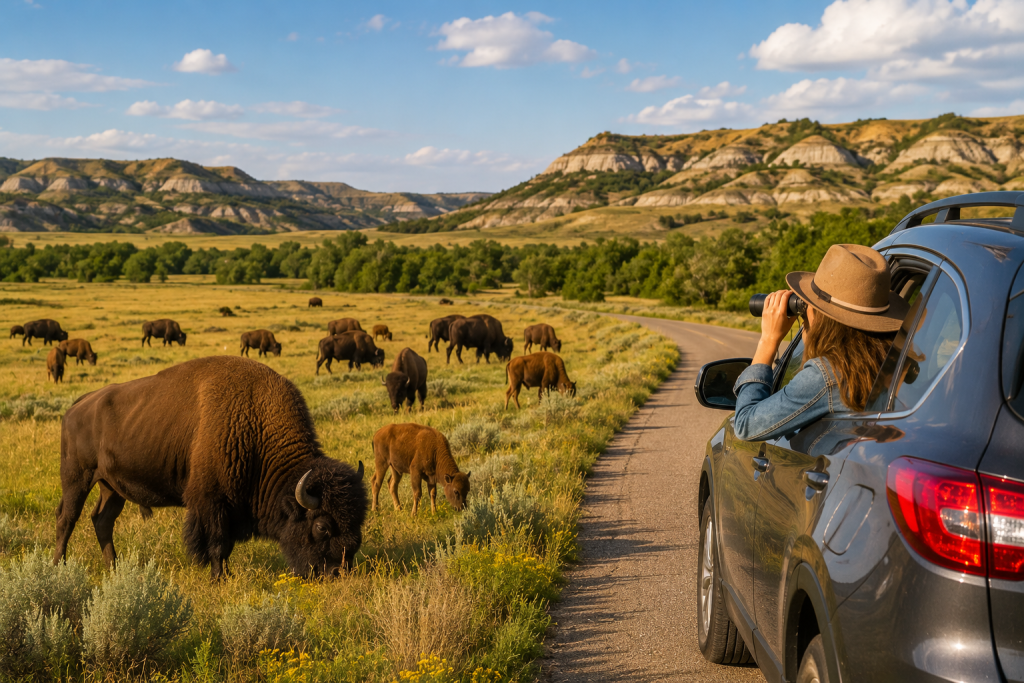
There’s a specific thing that happens when you’re driving the North Unit scenic drive at 6:30 in the morning in July and you come around a coulee bend and there’s a bison herd spread across the meadow in front of you, forty animals moving slowly through the morning light with the badlands terrain behind them. It’s genuinely startling, even when you were looking for it. That experience is 14 miles south of Watford City and it’s one of the better reasons to wake up early in North Dakota.
The North Unit of Theodore Roosevelt National Park is home to a free-roaming bison herd that the National Park Service manages as part of the unit’s ecological restoration mission. Bison were reintroduced to the North Unit in 1962 — the same year the herd was established in the park’s South Unit near Medora — and the population has been maintained since through periodic culling that prevents the herd from exceeding the unit’s carrying capacity. The current North Unit herd numbers somewhere between 100 and 300 animals depending on the season and recent management activity, ranging across the 24,000-acre unit throughout the year.
For visitors staying at Watford City RV Park, the North Unit is 14 miles south on US-85 — a 20-minute drive to the entrance station and then the 14-mile scenic drive down to the Oxbow Overlook. The bison don’t live at a specific address on that route, but they’re in there, and knowing where and when to look significantly increases the probability of a meaningful encounter rather than a drive-through with no wildlife in sight.
Understanding the North Unit Bison Herd
The North Unit bison are not fenced within a defined paddock. They move throughout the unit’s terrain — the river bottom, the meadows adjacent to the Little Missouri, the upland grasslands between the buttes, and the draw areas in the coulee systems. Their movement within the unit follows patterns influenced by season, temperature, forage availability, and the daily heat cycle in summer.
In July, the relevant movement pattern is the same one that governs most large ungulate behavior in the Northern Plains summer: activity concentrates in the cooler bookend hours of the day, and the hottest midday period drives animals toward shade and lower-activity positions. Bison move, feed, and interact socially in the morning and evening; they stand in shade or lie down during the 11 a.m. to 4 p.m. heat peak. This is not always true — bison in the river bottom can be active at any hour because the water and tree shade there reduce the heat stress that the open ridgelines can’t — but it’s the pattern that holds often enough to structure a viewing strategy around it.
“The North Unit bison have no particular reason to be visible from the road at any given time. They’re a free-roaming herd on 24,000 acres. What the morning and evening timing does is catch them when they’re actively feeding and moving in the meadow zones that are closest to the scenic drive, rather than sitting in the shaded coulee bottoms where you can’t see them from the car.”
Where to Look: The Best Viewing Locations on the Scenic Drive
The River Bottom: Mile 3 to Mile 6
The early stretch of the North Unit scenic drive, between approximately mile 3 and mile 6 from the entrance, runs along the Little Missouri River bottom corridor. The river and the cottonwood and green ash trees along its banks produce the habitat that keeps bison in this area more consistently than the exposed ridgeline terrain — the shade, the water access, and the riparian forage keep animals in this corridor even during the midday hours when the open country drives them to shelter. The first open meadow views of the river bottom, accessible from the road pullouts in this section, produce some of the North Unit’s most reliable and closest bison encounters.
Looking specifically at the willows and grasses along the river edge in this section — bison blend into the riparian vegetation surprisingly well for animals of their size — and scanning systematically across the visible meadow rather than just looking ahead is the viewing technique that finds animals that a casual drive-through would miss. Binoculars are worth having here specifically.
The Upper Scenic Drive: Mile 8 to Mile 12
As the scenic drive climbs out of the river bottom and into the upland badlands terrain, the character of the viewing changes. The river bottom is behind you, replaced by open butte-and-coulee terrain where sightlines extend much further but animals can be equally far away. In the morning and evening, bison herds are sometimes visible from the ridgeline road in the middle-distance — animals in the open grassland zones between butte formations, visible as dark shapes against the lighter clay and grass backdrop.
The Achenbach Hills area and the upper terrain approaching the Oxbow Overlook produce less frequent but often more dramatic bison encounters — a herd of twenty or thirty animals on an open ridgeline with the badlands terrain as the backdrop is the landscape photography situation that visitors specifically drive to the North Unit to find. It doesn’t happen every drive, but when it does, it happens in this section more often than in the river bottom.
The Oxbow Overlook: The Terminal View
At the end of the 14-mile drive, the Oxbow Overlook sits above the Little Missouri River’s dramatic bend, with a view down into the river bottom below. Bison in the river bottom near the oxbow are visible from the overlook — small at this distance but their characteristic silhouette (heavy forequarters, distinctive shoulder hump, dark color against the lighter river corridor vegetation) is identifiable from the overlook elevation. On good mornings, bison visible in the river bottom from the overlook while the sun is still low are the standard combination of the overlook’s two best features at once.
The Best Time of Day for Bison Watching in July
The single most impactful decision for bison viewing in the North Unit in July is what time you arrive at the park entrance. Early morning is not just marginally better — in summer, it’s categorically better. The difference between arriving at 6:30 a.m. and arriving at 11 a.m. is the difference between seeing a herd actively feeding in an open meadow and seeing no visible bison because they’ve moved to shade in the draws where they’re not accessible from the road.
From Watford City RV Park, leaving by 6 a.m. puts you at the North Unit entrance when it opens (the park is accessible at sunrise year-round) and gives you the full morning window on the scenic drive before the day’s heat has peaked. The round trip to the Oxbow Overlook and back, with stops at the river bottom pullouts and whatever wildlife encounters develop along the way, typically takes two to three hours — which means finishing the drive by 9 or 9:30 a.m. and being back in Watford City before the heat of the day is fully committed to its July performance.
The evening window — arriving at the park entrance around 6 or 6:30 p.m. and driving the scenic route with the low western sun behind you — produces the same activity pattern reversal that the morning does, and the lighting quality for photography is exceptional in the late afternoon and early evening hours at this latitude.
Other Wildlife on the North Unit Scenic Drive
Bison are the headliner, but the North Unit wildlife population is broader. The free-roaming horses — designated by the NPS as “free-roaming horses” rather than feral horses, reflecting their management status — are present in the unit and visible from the scenic drive on many morning and evening sessions. White-tailed and mule deer are common in the river bottom area, particularly in the willows and at the meadow edges at dawn. Pronghorn antelope are present in the unit’s grassland areas. Prairie dogs maintain colonies near the entrance area and near the upper scenic drive sections. Elk were reintroduced to the unit in relatively recent park management history and are occasionally seen in the later summer months.
North Unit bison viewing quick reference — from Watford City RV Park: Distance: 14 miles south on US-85 to North Unit entrance. Drive time: 20 minutes. Best viewing windows: 6:00–9:30 a.m. and 6:00–9:30 p.m. Summer midday (10 a.m.–5 p.m.) produces dramatically fewer sightings. Best road locations: River bottom section (miles 3–6) for consistent, close encounters. Upper terrain (miles 8–12) for dramatic open-country herd sightings. Oxbow Overlook for river bottom visibility from elevation. Equipment: binoculars essential. Polarizing filter for photography if shooting through car windows. Long lens if photography is a priority. Herd size: 100–300 animals managed by NPS. Not guaranteed sightings but reliable with correct timing. Entrance fee: $35/vehicle 7-day or America the Beautiful annual pass. Safety: stay inside or adjacent to vehicle. Minimum 100 yards from bison. Do not approach on foot.
For oilfield workers using Watford City as a base who want to spend off-rotation mornings at the North Unit, the oilfield worker housing at Watford City RV Park covers the base-camp logistics for an extended stay. Extended visitors who want monthly rates to make repeat North Unit mornings economical can check the monthly RV sites in Watford City. Travelers approaching from the New Town and Fort Berthold corridor to the east can check the RV park near New Town, ND page. And for planning any stay with North Unit access in mind, Watford City RV Park is the starting point.
Frequently Asked Questions
How many bison are in the Theodore Roosevelt National Park North Unit?
The North Unit bison herd is managed by the National Park Service at a population of approximately 100 to 300 animals, with the specific number varying by season and recent management activity. The herd was reintroduced to the North Unit in 1962 and is maintained through periodic culling to prevent overpopulation relative to the unit’s 24,000-acre carrying capacity. The NPS publishes current herd management information through the Theodore Roosevelt National Park website (nps.gov/thro). The bison range freely across the entire unit; they are not penned or confined to a specific area of the scenic drive, which means sighting probability varies by time of day, weather, and seasonal grazing patterns.
Is it guaranteed you’ll see bison at the North Unit?
No guarantee — but with the right timing, the probability of a meaningful sighting is high. The North Unit has consistently been one of the more reliable bison viewing destinations in the Northern Plains precisely because the scenic drive road runs directly through the unit’s core habitat rather than along the perimeter. Visitors who arrive in the morning window (6 to 9:30 a.m.) or evening window (6 to 9:30 p.m.) during the summer season, drive the full 14-mile scenic route to the Oxbow Overlook and back, and stop at pullouts to scan the river bottom and upland meadows will see bison on the majority of visits. Visitors who arrive at midday on a hot July day and drive the route quickly without scanning will miss the herd more often than not, even on a day when 200 animals are somewhere in the unit.
How close do bison come to the road in the North Unit?
Bison in the North Unit frequently approach the road or cross it — the scenic drive goes through their habitat rather than around it, and animals that have grown accustomed to slow-moving vehicle traffic don’t maintain a fixed buffer from the road. Roadside bison encounters in the North Unit — animals within 20 to 50 feet of the vehicle — are common, and bison crossing the road in front of slow-moving visitor vehicles happen regularly on mornings and evenings when the herd is active in the river bottom and meadow zones near the road. The appropriate response is to stop the vehicle, turn off the engine, observe quietly, and wait for the animals to move at their own pace. Do not honk, approach on foot, or exit the vehicle to get a closer photo. The National Park Service minimum safe distance for bison is 100 yards on foot — a rule that exists because bison can charge without warning at speeds that exceed human running capacity.
What is the best time of year to see bison at TRNP North Unit?
Summer (July through August) is one of the best periods for bison viewing in the North Unit specifically because the herd is in peak condition and full population following spring calving — July produces tan-colored calves alongside adults, which is the most visually complete herd composition of the year. The summer rutting season (typically late July through August) produces increased herd activity, vocalizations, and behavioral displays between bulls that are not present in other seasons. Fall (September through October) is also excellent — the herd has full summer weight, the calves are larger and more mobile, and the autumn light on the badlands terrain produces the best landscape photography conditions. Winter bison viewing requires more patience and cold-weather preparation but the smaller visitor volume and the bison’s heavy winter coat silhouette against snow produce a completely different visual experience.
What other wildlife can I see in the North Unit?
The North Unit wildlife beyond bison includes free-roaming horses (designated as such by the NPS, present year-round, frequently visible from the scenic drive), white-tailed and mule deer (most visible at dawn and dusk in the river bottom riparian area), pronghorn antelope (grassland areas of the upper unit), prairie dogs (colonies near the entrance area and upper scenic drive, active throughout the day), wild turkeys (river bottom and meadow edge, most commonly seen in the early morning), and elk (present in the unit following reintroduction, more commonly seen in late summer and fall). Golden eagles are year-round residents of the badlands terrain and frequently visible soaring on thermal updrafts above the buttes. Ferruginous hawks are seasonal breeding residents. The North Unit’s biodiversity is substantially higher than its size suggests, making the scenic drive a genuine wildlife experience even on a morning when the bison aren’t immediately visible from the road.
Is binoculars necessary for North Unit bison watching?
Highly recommended. The North Unit’s bison range across 24,000 acres and are frequently visible from the road at distances that make naked-eye identification reliable but close-up observation and photography challenging without optical assistance. A standard 8×42 or 10×42 binocular gives the magnification to observe individual animals, read behavioral cues, and identify calves within a herd at the middle distances that the North Unit’s terrain typically provides. For photography, a lens in the 200mm to 400mm range on a crop-sensor camera gives the field of view appropriate for bison at typical road-encounter distances. A 50mm or wider lens will capture the landscape but not fill the frame with individual animals at the distances most sightings occur. Binoculars are also useful for scanning the river bottom from the Oxbow Overlook, where animals visible in the meadow below are at a distance that benefits from optical magnification even for basic identification.