

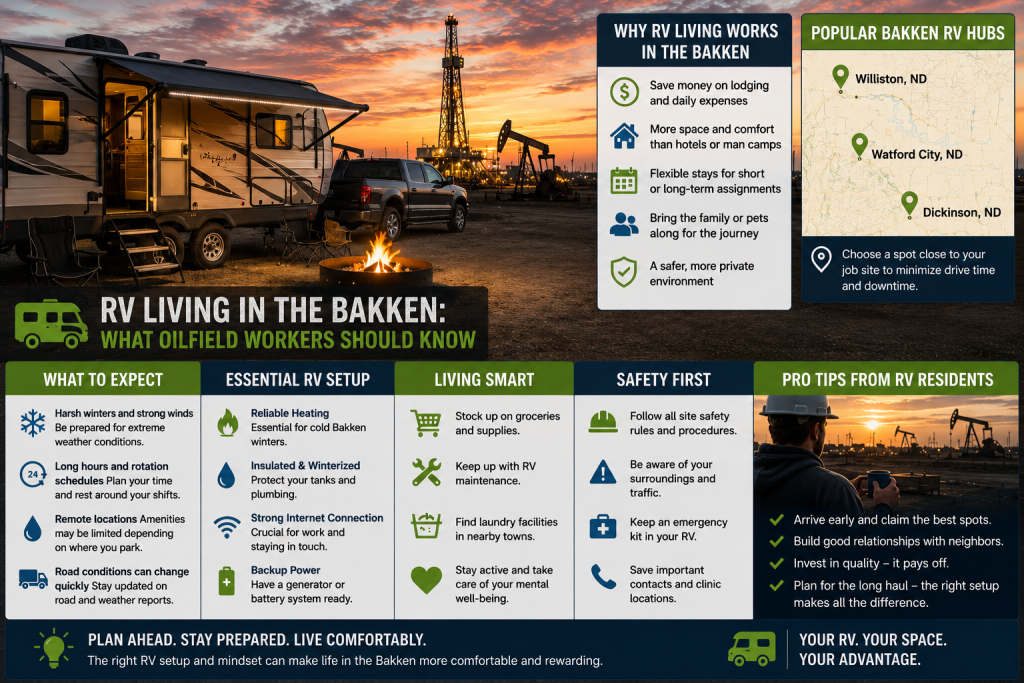
Coming to the Bakken for work is a specific kind of relocation — often fast, sometimes with minimal lead time, and always into an environment that has its own rules about what housing actually means. This guide covers what you actually need to know.
Most of the housing decisions that workers make before heading to the Bakken are made with incomplete information. They know the work is there. They know the pay is good. What they often don’t fully account for is the housing situation on the ground — what’s available, what it costs, and what the genuine tradeoffs are between the options.
RV living in the Bakken has been the choice of a significant portion of the oilfield workforce for over a decade now, and not by accident. It’s not the obvious choice when you’re coming from a part of the country where everyone has a house or apartment. But once you understand the alternatives and the economics, it tends to make a lot of sense — especially for workers on rotation schedules who need something flexible, functional, and genuinely affordable over a multi-month assignment.
This guide covers the full picture: why workers choose RV living, what the experience is actually like, what you need to know about winter, and how to find the right Bakken housing situation before you arrive.
The Housing Options in the Bakken — Honestly
Before getting into the RV option specifically, it helps to understand the full field of housing choices available to workers coming to the Bakken, because the context matters.
Man Camps (Workforce Housing)
Workforce housing complexes — commonly called man camps — are employer-provided or contracted dormitory-style accommodations built specifically for the oilfield workforce. They offer a bed, meals in a common cafeteria, basic amenities, and nothing resembling a personal living space. Some operations provide these as part of the compensation package; others deduct them from pay. Man camps solve the logistics problem of housing a large mobile workforce, but they don’t provide the separation between work environment and personal space that most people need for mental health and sustainability during a long rotation.
After several months in a man camp, the lack of any genuine private space — your own kitchen, your own living area, some control over your immediate environment — becomes a real quality-of-life issue for most people. The workers who do best on long Bakken assignments typically find accommodation that gives them their own space on time off.
Apartments and Rental Housing
Rental housing exists in Watford City, Williston, and surrounding communities, but availability and pricing fluctuate significantly with oil prices and oilfield activity levels. During active periods, vacancy rates are low and prices are high — the boom built a housing demand that the permanent housing stock took years to catch up with and still doesn’t fully serve at peak activity. Long-term leases are a commitment that rotation-schedule workers often can’t make without accepting penalty risk if the assignment ends or changes.
RV Living
Oilfield RV living emerged as the dominant choice for a large portion of the Bakken workforce because it solves the specific problems that man camps and apartments don’t. Your own space. Your own kitchen. Your own schedule in your own home. And critically — flexibility. If the assignment ends, you drive home. If it changes locations, you move your home. No lease to break, no roommate to negotiate with, no cafeteria schedule to accommodate.
“The workers who’ve been in the Bakken for multiple seasons will usually tell you the same thing: get your own rig. Stop sharing space with forty other guys in a camp.”
Why Workers Choose RV Living in the Bakken
The practical case for extended stay RV in the Bakken comes down to four specific advantages that matter for this workforce.
Economics
Monthly RV site rates at established parks near Watford City typically run $400 to $700 per month. Hotel stays in the same area run $100 to $180 per night — or $3,000 to $5,400 for a 30-day period. Apartment rents during peak activity periods have run $1,500 to $2,500 per month for modest units. The RV site, for workers who own their rig, is by far the most economical option on a monthly basis. Over a six-month rotation, the cost difference can be $10,000 to $25,000 — meaningful money even on good oilfield wages.
Your Own Space and Kitchen
Working 12-hour shifts in physically demanding conditions requires genuine recovery time. Recovery doesn’t happen in a man camp where there’s no separation from coworkers, no control over noise, and no ability to eat what you actually want when you want it. An RV gives you the separation. You decide when the lights go out. You cook your own food. You have a space that is genuinely yours rather than a bunk in a shared facility.
Rotation Schedule Compatibility
Working in North Dakota oil typically involves rotation schedules — two weeks on, one week off, or similar configurations — rather than traditional weekly employment. This pattern creates accommodation needs that standard housing doesn’t serve well. Monthly apartment leases charge you for the week you’re away. Man camp charges may or may not be suspended during off-rotation. An RV monthly site typically provides a home base that persists through your rotation schedule at a predictable cost regardless of when you’re physically present.
Flexibility and Mobility
Oilfield assignments change. Companies change work priorities, projects finish ahead of schedule, better opportunities come up elsewhere in the field. Workers who are locked into apartment leases or employer housing have friction around these changes. Workers living in an RV at a monthly site have maximum flexibility — they can stay, they can move to a different site closer to the new work location, or they can drive home at the end of an assignment without leaving anything behind. That flexibility has real value in an industry where certainty about assignment duration is limited.
The Winter Reality: This Is Not Optional Knowledge
North Dakota winters are one of the more significant practical challenges of Bakken housing for anyone who hasn’t lived in a severe-winter state. This section is not meant to discourage workers from choosing RV living — it’s meant to ensure they arrive prepared rather than discover the problem in January.
Watford City regularly sees temperatures below -20°F in January and February. Windchill values below -40°F are not rare. This is extreme cold by any standard, and RVs — even well-built ones — are not designed for continuous operation in these temperatures without specific cold-weather preparation.
What Your Rig Needs for Bakken Winter
Underbelly insulation and heated underbelly bays are essential for keeping water lines and holding tanks from freezing. Factory “Arctic packages” or equivalent aftermarket insulation are not optional — they’re baseline requirements. A heated water hose connecting to the park pedestal is necessary for continuous water supply. A quality propane furnace or electric heating system with adequate BTU capacity for extreme cold is non-negotiable. Skirting the rig to trap ground-level heat is standard practice among experienced Bakken winter residents and makes a significant difference in heating efficiency and water line protection.
Workers arriving in the Bakken in late summer or fall for a first winter assignment need to assess their rig’s winter capability before they arrive, not after. Finding out in December that your rig’s heating system can’t keep up with -20°F is a miserable way to learn this lesson.
Bakken winter RV checklist: Heated underbelly or appropriate insulation package. Heated water hose for the hookup connection. Adequate BTU heating capacity for -30°F ambient (not just -10°F). Skirting material and installation. Diesel fuel treatment to prevent gelling at low temperatures. Extra propane supply capacity. Emergency backup heat source. Quality sleeping bag rated for well below zero as a precaution. Stock of essential supplies that doesn’t require a daily supply run in extreme weather.
Finding the Right Site: Watford City and Surroundings
Site selection matters for practical reasons beyond just price. Proximity to your work location affects pre-shift and post-shift drive time, which adds up significantly over a rotation. Site quality — electrical service, water pressure, road surface in winter conditions — affects daily life more than workers who haven’t done this before typically expect.
The oilfield worker housing options in Watford City are specifically designed around the workforce’s needs — monthly pricing structures, full hookup infrastructure, and the operational approach of a property that understands it’s serving people who work demanding schedules and need their home base to function reliably. The monthly RV site options in Watford City cover the specifics of long-term site availability and pricing.
For workers whose assignments are closer to Williston than to Watford City, the RV park near Williston, ND gives you the same quality infrastructure positioned for that part of the Bakken. And for everything about the park and what it offers to Bakken workers specifically, Watford City RV Park is the starting point for planning your housing before you arrive.
Frequently Asked Questions
Is RV living cheaper than an apartment in Watford City?
For workers who own their RV, yes — significantly. Monthly RV site rates in the Watford City area typically run $400 to $700 per month, while apartment rents during active periods have run $1,500 to $2,500+ per month for modest units. Over a six-month assignment, the difference can be $6,000 to $12,000 or more. For workers who need to rent an RV, the comparison is closer but typically still favorable depending on the rental cost. The larger economic case for RV ownership — amortized over multiple Bakken assignments — is usually clear for workers planning to be in the industry for multiple seasons.
Can I realistically live in an RV through a North Dakota winter?
Yes, but only with a rig that is properly equipped for extreme cold. Workers do it every year successfully. The requirements are specific: heated underbelly or Arctic insulation package, heated water hose, adequate heating system BTU capacity for -30°F ambient temperatures, skirting, and winter-specific operational practices. An unprepared rig in a North Dakota winter is a serious problem. An appropriately winterized rig with a quality heating system is a livable, comfortable home base through even the harshest months. Arriving in late summer gives you time to assess and address winter readiness before cold weather arrives.
How do rotation schedules work with monthly RV site rates?
Monthly site rates at Bakken RV parks are typically charged by the calendar month rather than by the days physically present. Your site is yours for the month regardless of your rotation schedule — which is actually a significant advantage, because it means you have a stable home base that’s there when you come back from your week off rather than needing to find a new site each rotation. The predictable monthly cost, regardless of rotation schedule, makes budgeting straightforward. Discuss your rotation schedule with the park when booking to confirm the rate structure and any considerations for extended periods of absence.
What size RV makes sense for Bakken oilfield living?
For single workers, a Class C motorhome or a well-equipped fifth wheel in the 25-35 foot range provides a comfortable living space without being so large that it becomes difficult to manage in tight site configurations. The priorities for Bakken work living are: adequate sleeping space for proper rest after long shifts, a functional kitchen, a good bathroom, and heating capacity appropriate for extreme cold. For workers with families who visit during off-rotation periods, a larger fifth wheel or Class A in the 35-42 foot range makes more sense. The single most important feature specification is winter heating capacity — prioritize this above layout preferences when selecting a rig for Bakken use.
Where should I stay in the Bakken if I work near Williston versus Watford City?
Williston and Watford City are approximately 60 miles apart on US-85 — a manageable drive but one that adds up over a full rotation when you’re doing it twice daily. Workers whose primary job site is consistently closer to Williston will benefit from finding accommodation in that direction rather than anchoring in Watford City. Workers whose sites are in the McKenzie County production zone south and east of Watford City are typically better positioned from a Watford City base. Discussing the general location of your work area with the park helps them advise on the most practical site location, and some workers change their base seasonally as work moves between different parts of the Bakken.
What services and amenities do I need at a Bakken RV park?
The non-negotiables for oilfield workers are full hookups (electrical — both 30 and 50 amp depending on your rig — water, and sewer), reliable electrical service that handles full rig load, laundry facilities (self-service laundry on-site dramatically simplifies life on a rotating schedule), and internet connectivity adequate for remote communication during time off. Secondary priorities include proximity to fuel (diesel or propane depending on your rig’s systems), proximity to a grocery option, and site configuration that accommodates your specific rig size and slideout requirements. Sites that also offer some outdoor personal space — not just a gravel pad — contribute meaningfully to quality of life over extended stays.