

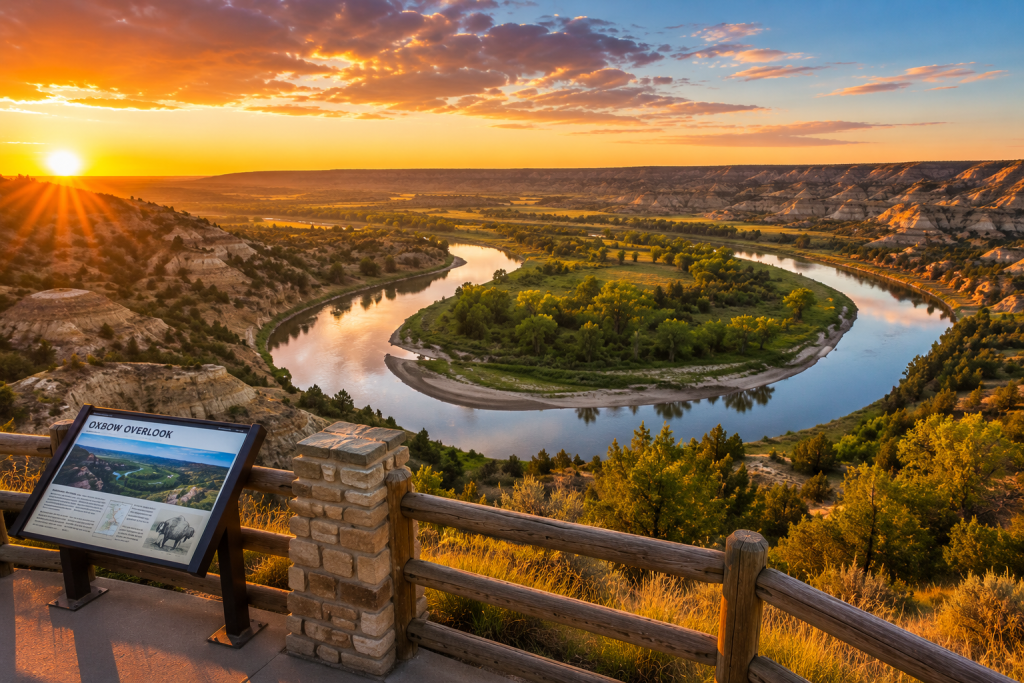
The Oxbow Overlook is the terminal viewpoint of the North Unit scenic drive — 14 miles from the entrance, above a broad oxbow bend in the Little Missouri River, with the badlands stretching in every direction at a scale that takes a moment to process. Getting there at the right time of day in July makes the difference between an experience you spend the rest of the summer thinking about and one that was just hot and bright and over quickly.
Theodore Roosevelt National Park’s North Unit is 14 miles south of Watford City on US-85, and the Oxbow Overlook is the reason most people drive the full scenic route rather than stopping halfway. The view from the overlook — the Little Missouri River curving through the badlands below, the layered terrain of clay buttes and juniper in every direction, the enormous sky that North Dakota specifically produces — is the one that ends up on camera rolls and becomes the trip’s defining image. The question is when to go.
Why Timing Matters in July
July at TRNP North Unit creates three distinct challenges that make visit timing more consequential than it is in spring or fall. First, the heat: July highs near Watford City run into the upper 80s to low 90s°F, and the North Unit’s exposed terrain — clay buttes, little shade, direct sun on the scenic drive — makes those temperatures feel hotter than the reading suggests. The difference between being at the Oxbow Overlook at 7 a.m. and at 1 p.m. is not a small difference.
Second, wildlife activity: bison, deer, feral horses, and the other species the North Unit is known for are most active during the cooler bookend hours of the day. Midday July heat pushes them into shade and lower visibility positions. The spectacular bison sightings that visitors describe — animals close to the road, moving unhurriedly through open terrain — happen in the morning and evening windows, not the midday plateau.
Third, light quality: the North Unit’s badlands terrain is specifically responsive to low-angle directional light. The ochre and sienna clay buttes, the shadowed coulee folds, the river bottom below the Oxbow — all of these look different and dramatically better in morning and late-afternoon light than in the flat midday sun that washes out color and flattens the terrain’s dimensionality.
“The Oxbow Overlook at 7 a.m. in early July, with the sun still low and the shadows long across the badlands and maybe a bison herd visible on the river bottom, is the version of this place that people come back for. The 12:30 p.m. version is still a view, but it’s a different trip.”
The Early Morning Window: 6 to 9 a.m.
The early morning window is unambiguously the best time to visit the North Unit in July — for the overlook specifically and for the entire scenic drive in general. At 6 to 6:30 a.m., the air temperature is in the upper 60s to low 70s°F, which feels remarkable against the knowledge that it’ll be 92°F by 2 p.m. The sun rises around 5:45 a.m. in early July at this latitude (approximately 47.8°N), and by 6:30 a.m. it’s already producing that specific low-angle light that gives the badlands terrain its saturated color and deep-shadow dimensionality.
Wildlife is at peak activity in the first two to three hours after sunrise. The bison herds that the North Unit is most famous for tend to feed and move during the cooler morning hours, often visible from the scenic drive road itself rather than requiring a hike or a spotting scope. The feral horses (properly called “free-roaming horses” by the NPS) are also most active in the morning. On a good morning in early July, the 14-mile drive from the entrance to the Oxbow Overlook can produce a dozen or more wildlife sightings in addition to the overlook itself.
Practical Morning Logistics
The North Unit entrance opens at sunrise year-round — there’s no gate that prevents early access. The 14-mile scenic drive from the entrance to the Oxbow Overlook takes approximately 45 minutes to an hour if you stop at the pullouts along the way (and stopping at the pullouts is how you find the wildlife — the road itself doesn’t always reveal everything that’s 50 feet off the pavement). Plan to leave Watford City no later than 6 a.m. for a July morning session. The drive to the park entrance on US-85 is 14 miles from Watford City — about 20 minutes.
The Midday Reality: 10 a.m. to 4 p.m.
The middle of the July day at the North Unit is worth understanding honestly rather than describing diplomatically. By 10 a.m., the temperature at the Oxbow Overlook is already in the high 80s and climbing. The exposed viewpoint at the end of the drive has no shade — it’s a paved overlook platform on an open ridgeline. By noon, it’s regularly over 90°F in direct sun on the unshaded platform, and the badlands terrain below is at full midday brightness with colors washed out relative to the morning and evening versions of the same view.
Wildlife has retreated to shade. The bison herds visible in the river bottom at 7 a.m. are now in the juniper draws or behind coulee ridgelines, not visible from the road. The feral horses are in the tree-line shade. The afternoon visitor who drives the full scenic drive hoping for the bison experience may see little to no wildlife between 11 a.m. and 4 p.m. on a hot July day.
This doesn’t mean the midday visit has no value — the geology is extraordinary at any hour, and the overlook itself is still one of the more spectacular viewpoints in the Northern Plains regardless of light quality. But the full North Unit experience that combines wildlife, light quality, and comfortable outdoor conditions is a morning and evening phenomenon in July.
The Late Afternoon and Evening Window: 6 to 9:30 p.m.
The evening window is the second best option and has a specific quality the morning doesn’t: the July sunset at this latitude doesn’t arrive until approximately 9:30 p.m., which means the North Unit scenic drive in the evening produces 90+ minutes of golden-hour quality light starting around 8 p.m. The badlands terrain in that specific late-afternoon light — warm, directional, with long shadows thrown across the buttes and into the coulee folds — produces the landscape photography that specifically defined Ansel Adams-era badlands images.
Wildlife activity resumes after the heat of the day eases — typically after 6 p.m. when the temperature starts dropping back toward the 80s. The bison that were invisible at noon are back in the open meadows and along the river bottom by 7 p.m. For visitors staying in Watford City who want both the morning and the evening experience in the park, the pattern of driving in at 6 a.m., leaving by 9, returning at 6 p.m., and staying through the 9:30 p.m. sunset is a complete July day that uses the park exactly as it was designed to be experienced.
The Caprock Coulee Trail: Morning Required
The North Unit’s primary hiking trail — the Caprock Coulee Trail, a 4.1-mile loop that descends into the badlands terrain rather than viewing it from above — is a July morning-only activity for practical reasons. The exposed trail has little shade and the significant grade changes between the rim and the coulee bottom produce body heat from exertion that compounds the ambient temperature. Starting the Caprock Coulee Trail after 9 a.m. in July is a heat management decision that requires specific preparation; starting at 6:30 a.m. is a qualitatively different experience that covers the most scenically dramatic terrain in the coolest available window.
TRNP North Unit July timing — quick reference: Best morning window: 6:00–9:00 a.m. Low temperatures (upper 60s–low 70s°F), peak wildlife activity, low-angle morning light on badlands. Leave Watford City by 6 a.m. Midday: 10 a.m.–4 p.m. Hot, bright, wildlife minimally visible. Manageable with heat preparation but not peak experience. Best evening window: 6:00–9:30 p.m. Temperature dropping into 80s, wildlife active again, 90+ minutes of golden-hour light before ~9:30 p.m. sunset. Caprock Coulee Trail (4.1 mi): morning only in July. Start by 7 a.m. for the full comfortable experience. Entrance fee: America the Beautiful annual pass or $35/vehicle 7-day pass. No gate — park opens at sunrise year-round. Distance from Watford City: 14 miles south on US-85, approximately 20 minutes to entrance.
For travelers using Watford City as a base for North Unit visits, the RV park near Theodore Roosevelt National Park gives the full proximity picture. The monthly RV sites in Watford City cover extended-stay options for visitors spending multiple weeks using the park. For oilfield workers with off-rotation days who want to use the early morning July window, the oilfield worker housing at Watford City RV Park covers what the base camp logistics look like. And for all stay planning, Watford City RV Park is the starting point.
Frequently Asked Questions
What is the Oxbow Overlook at Theodore Roosevelt National Park?
The Oxbow Overlook is the terminal viewpoint at the end of the 14-mile North Unit scenic drive in Theodore Roosevelt National Park (North Unit), located approximately 14 miles south of Watford City, North Dakota, on US-85. The overlook sits above a dramatic oxbow bend in the Little Missouri River — a point where the river curves back nearly on itself, creating the horseshoe-shaped loop that defines an oxbow. The viewpoint provides a panoramic view of the badlands terrain including the river bottom, clay buttes, juniper-covered slopes, and the expansive sky above McKenzie County. It is widely considered one of the most spectacular viewpoints in the Northern Plains.
What is the best time of day to see bison at the North Unit in July?
The best bison viewing windows at the North Unit in July are early morning (6 to 9 a.m.) and late evening (6 to 9 p.m.), when temperatures are in the comfortable range and animals are actively feeding and moving. During midday July heat — roughly 10 a.m. to 4 p.m. — bison herds typically retreat to shaded areas in the juniper draws and coulee bottoms, where they are less visible from the scenic drive road. The North Unit’s bison population is not concentrated in a single area; they move throughout the unit and sightings are always variable, but the probability of roadside bison sightings is significantly higher during the morning and evening activity windows than during the midday heat period.
How long is the North Unit scenic drive and how long does it take?
The North Unit scenic drive runs 14 miles from the entrance station to the Oxbow Overlook — 14 miles in and 14 miles back out, for a total of 28 miles round trip. The drive takes approximately 1.5 to 2.5 hours round trip depending on how often you stop at the scenic pullouts and wildlife sighting areas along the route. Stopping at all the named pullouts — River Bend Overlook, Bentonite Clay Overlook, Cannonball Concretions pullout, and others — is worth the time; each gives a different perspective on the badlands geology. In the morning with multiple stops and wildlife encounters, a round trip from entrance to Oxbow Overlook and back can easily fill three hours without ever leaving the paved road.
Is there shade at the Oxbow Overlook?
There is minimal to no shade at the Oxbow Overlook itself — it is a paved viewpoint on an exposed ridgeline with no overhead cover and no tree canopy. In July, this means the overlook in direct midday sun is a full-exposure environment where UV intensity and reflected heat from the paved surface compound the ambient air temperature. Visiting in the early morning (when the sun is low and the temperature is in the 70s°F) or the late evening (when the sun is similarly low and the day’s peak heat has passed) is strongly advisable. Sun protection — sunscreen, wide-brim hat — applied before leaving the vehicle is essential for any July visit regardless of the time of day, since the overlook offers no shaded recovery position.
What is the entrance fee for Theodore Roosevelt National Park North Unit in 2026?
The Theodore Roosevelt National Park entrance fee for a private non-commercial vehicle is $35 for a 7-day pass (valid for both the North and South Units). The America the Beautiful annual pass (also called the Interagency Annual Pass), available for $80 at the park entrance or through recreation.gov, covers entrance to all US federal lands managed by the NPS, USFS, BLM, FWS, and Bureau of Reclamation for 12 months and is the best value for visitors planning to visit multiple national parks or other federal lands during the year. The North Unit has no staffed entrance gate — the payment system operates on an honor system with an iron ranger payment station near the entrance. The park is open year-round.
Can I see the feral horses at the North Unit in July?
Yes. The free-roaming horses of the North Unit (historically referred to as feral horses; the NPS designates them as “free-roaming horses” to reflect their management status) are present in the North Unit year-round and visible from the scenic drive on most visits. Like bison, they are most active during the cooler morning and evening hours in July and tend to seek shade during midday heat. The horses in the North Unit are not shy around vehicles — they’re accustomed to the slow-moving scenic drive traffic — and when encountered near the road, they can be observed closely from the vehicle window without any disturbance. Sightings cannot be guaranteed on any specific visit, but morning drive visitors see them with some regularity during July.