

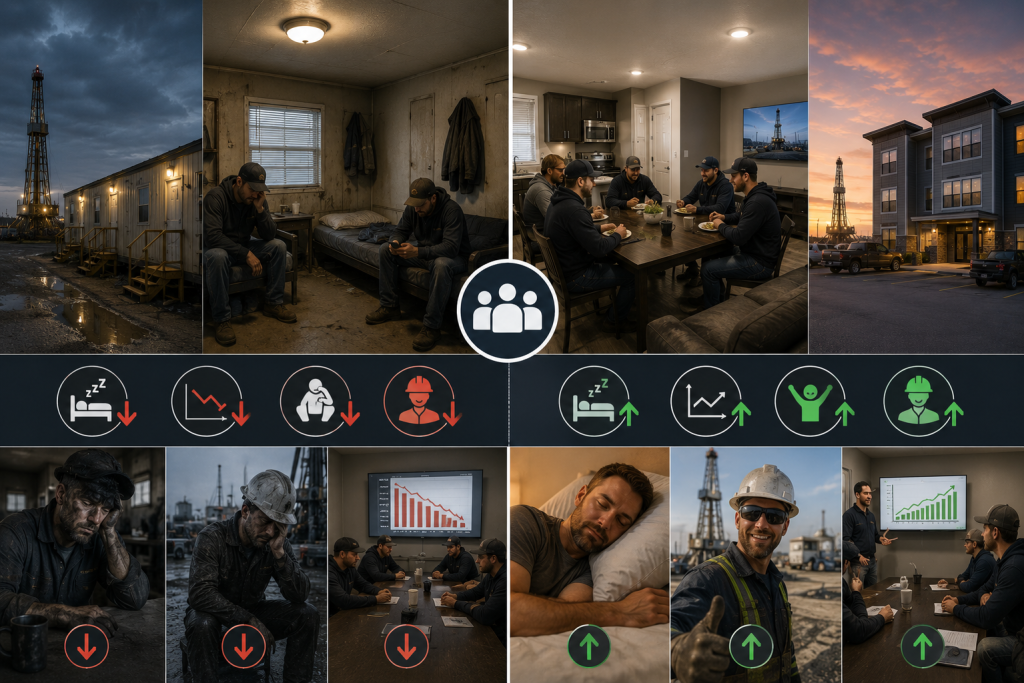
When operations managers look for ways to improve crew productivity in the Bakken, they usually focus on the obvious variables: equipment reliability, scheduling efficiency, crew experience, and site conditions. Housing rarely makes the list.
That’s a mistake.
Where your workers sleep — and how well they sleep — has a direct, measurable impact on how they perform the next day. This isn’t a soft HR argument. It’s backed by occupational health research, and it’s visible in the field to anyone who’s managed crews long enough to notice the pattern.
This post makes the case that housing quality is a productivity variable, not just a logistics problem — and gives managers a practical framework for what to do about it.
The Sleep-Performance Connection in Physically Demanding Work
Oil field work is physically demanding by definition. Twelve-hour shifts, often in extreme temperatures, requiring sustained concentration and physical capability. The recovery window between shifts — typically eight to twelve hours — is where the body and mind restore themselves for the next day’s performance.
Sleep quality during that window is the critical variable. And housing conditions are one of the primary determinants of sleep quality.
Research on sleep deprivation in physically demanding occupations consistently shows:
- Cognitive function begins degrading after as little as one night of poor sleep
- Physical reaction time and coordination decline measurably with accumulated sleep debt
- Decision-making quality drops significantly under sleep-deprived conditions
- The effects compound across consecutive nights of poor sleep, meaning a worker four days into a bad-sleep streak is performing at a fraction of their rested capacity
In an oil field environment — where equipment operation, safety protocols, and physical coordination are all central to daily work — these aren’t abstract concerns. They translate directly into slower work, more errors, and higher incident risk.
How Bad Housing Creates Bad Sleep
The connection between housing quality and sleep is straightforward once you spell it out. Here’s how poor housing conditions directly disrupt recovery:
Noise. A worker in a man camp shared unit with thin walls and a rotating cast of neighbors at different shift times rarely gets uninterrupted sleep. Even workers on consistent shifts are affected by those around them on different schedules.
Temperature. Inadequate climate control — which is common in lower-end facilities in North Dakota’s extreme seasonal range — forces workers to sleep in discomfort. Both heat and cold disrupt sleep continuity in ways that feel minor in the moment but accumulate across a rotation.
Stress about basic logistics. Workers who are dealing with unreliable hookups, broken facilities, or housing uncertainty aren’t fully in recovery mode when they’re off shift. Cognitive load from unresolved housing problems bleeds into rest time.
Commute fatigue. Workers in housing that requires a 45- to 60-minute commute to the job site are losing one to two hours of potential rest time daily compared to workers in housing closer to the work. Over a two-week rotation, that’s 14 to 28 hours of lost rest — a significant accumulated deficit.
Privacy and psychological recovery. Workers in shared accommodations without private space don’t fully decompress between shifts. The ability to close a door and have personal space isn’t a luxury — it’s part of genuine recovery.
What This Costs You in Productivity Terms
The productivity impact of sleep-compromised workers is difficult to calculate precisely, but the directional evidence is consistent: it’s meaningful, it accumulates across a rotation, and it often exceeds the cost of the housing upgrade that would have prevented it.
Consider a two-week rotation with a crew of eight workers. If poor housing conditions reduce effective performance by 10–15% — a conservative estimate based on occupational health literature on sleep deprivation — that reduction translates directly into slower task completion, more supervision required, higher error rates, and greater safety exposure.
For context: a 10% productivity reduction across eight workers for 14 days is the equivalent of losing more than 11 full-day worker shifts. If your daily labor cost per worker is $600–$800, that’s $6,600–$8,800 in effective lost productivity per rotation — likely far exceeding whatever you would have saved on cheaper housing.
The retention math is similarly stark. Workers who dread coming back to their housing arrangement don’t sign up for the next rotation. Replacement and onboarding costs for oil field workers vary, but recruiting, transport, and learning curve costs for a single replacement worker routinely run $3,000–$8,000 or more. If one retention failure per year can be traced to housing quality, the economics of upgrading housing are obvious.
What Good Housing Actually Provides
The housing conditions that support genuine recovery and next-day performance aren’t complicated or expensive. They’re:
Private space. A worker’s own RV or private room means they control their sleep environment — noise, temperature, light, and schedule. This is the single highest-impact variable.
Climate control. Adequate heating and cooling that the worker controls. In North Dakota, this ranges from -30°F winters to 95°F summers — both extremes are real and both disrupt sleep in uncontrolled environments.
Short commute. Housing within 20 to 35 minutes of the job site preserves rest time and reduces the cumulative fatigue load over a rotation. Every additional 15 minutes of daily commute is a meaningful recovery cost.
Reliable basics. Working water, stable electricity, maintained facilities. The absence of housing problems is not just a comfort factor — it removes a low-grade stressor that occupies cognitive bandwidth during recovery time.
Quiet. Particularly important for workers on non-standard shifts. Housing that provides acoustic separation from activity during sleep hours is a direct performance input.
Workers in RV parks with their own rigs check all five of these boxes by default — their own space, their own climate control, private bathroom, no shared walls. It’s one of the reasons workers with options consistently prefer this setup for long rotations.
What Managers Can Do: A Practical Framework
Treating housing as a productivity variable changes how you approach the booking decision. Here’s a practical framework:
Set a commute time standard. Establish a maximum acceptable one-way commute from housing to job site — 30 to 40 minutes is a reasonable benchmark — and filter all housing options against it. Don’t allow cost savings on housing to push workers past that threshold.
Prioritize private accommodations for longer rotations. For rotations beyond two weeks, the productivity and retention argument for private accommodations (RV parks over shared man camp units) strengthens significantly. Build that preference into your housing policy.
Survey workers after rotations. A simple three-question post-rotation check-in — how was your housing, how was your commute, would you come back — gives you data on which housing arrangements are working and which are driving attrition. Most managers don’t collect this information systematically, which means they keep repeating housing mistakes that workers quietly absorb and eventually vote on with their availability.
Calculate total cost, not nightly rate. Add estimated commute cost, productivity impact, and retention risk to the housing line item before comparing options. The cheapest housing rarely wins that comparison.
Build housing relationships in advance. Workforce parks that know you and your crew’s needs will accommodate your scheduling realities better than one-off bookings. A relationship with a park near your regular job sites is worth developing — particularly for rotation handoff logistics, site holding between rotations, and emergency availability when timelines shift.
The Bottom Line
Housing quality isn’t a soft perk for oil field workers. It’s a direct input into how they perform on shift — and by extension, into your project outcomes, your safety record, and your crew’s willingness to return.
The managers who understand this treat housing as a operational variable to be optimized, not a cost line to be minimized. The ones who don’t tend to be surprised by the downstream effects — lower performance in the second week of a rotation, workers who don’t come back, incident rates that tick upward when crews are fatigued.
The good news is that the upgrade from poor housing to genuinely good housing rarely costs what managers assume it does. The math usually runs the other way.