

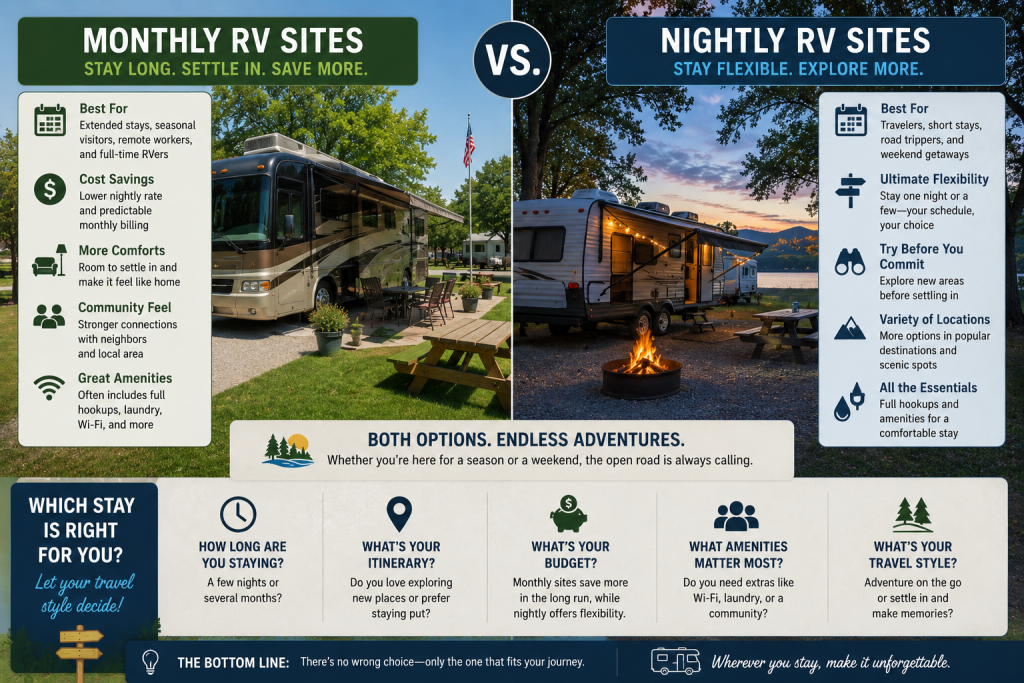
The answer comes down to how long you’re staying and what you’re actually using the site for. Simple as that — until you add the math, the flexibility question, and the specific context of the Bakken.
The nightly versus monthly decision at an RV park sounds straightforward, but in the Watford City area it has specific dimensions that the standard camping comparison doesn’t fully address. This isn’t the same question as choosing between nightly and monthly at a coastal resort or a state park campground. The Bakken has its own economics, its own workforce dynamics, and its own reasons why one rate structure is often clearly better than the other for a specific situation.
Whether you’re an oilfield worker planning your first Bakken rotation, a traveler spending more time in western North Dakota than you initially planned, or someone who just wants to understand the financial logic before committing to a site, this post breaks it down plainly. Monthly RV sites in Watford City vs. nightly — what’s the actual difference, when does each make sense, and what should you ask before you book.
The Basic Math: What Each Rate Structure Costs
The cost comparison between nightly and monthly rates is where the conversation usually starts, and it’s the right place to start — because the numbers make the decision for a lot of people before any other factor has to be weighed.
Nightly RV site rates in the Watford City area run roughly $50 to $80 per night for a full-hookup site at established parks. That range reflects differences in site quality, park amenities, and the specific hookup configuration (30-amp vs. 50-amp, site size). At $65 per night — a reasonable middle estimate — 30 nights costs $1,950.
Monthly full-hookup rates at established Watford City parks typically run $400 to $700 per month. The spread reflects similar factors as nightly rates — site quality, park infrastructure, and what’s included. At $550 per month — again, a reasonable middle estimate — the same 30 days costs $550.
The delta is $1,400 over a single month. Over a six-month Bakken rotation, that’s $8,400 in potential savings simply from choosing the right rate structure. The math argues for monthly rates clearly and consistently for any stay longer than two to three weeks. You’d have to find a nightly rate under $18 per night to make it competitive with a $550 monthly rate — and at that price point the site quality typically isn’t competitive anyway.
“The month-to-month rate wins on economics by such a wide margin that the only real reason to pay nightly is genuine uncertainty about how long you’re staying. If you know you’re there for a month, pay monthly.”
When Nightly Rates Make Sense
Nightly RV park rates exist for good reasons and serve real needs. They’re not a ripoff for people who actually need them. The question is just whether your situation is one where they apply.
True Short Visits
If you’re in Watford City for two to five days — a scouting trip before a rotation starts, passing through on a longer route, visiting family in the area — nightly is obviously right. The monthly rate doesn’t recoup over short stays; you’d pay a full month for four nights, which makes no sense.
Genuine Uncertainty
Oilfield work has variable timelines. An assignment that was supposed to last three weeks might end in one. A rotation that should have wrapped up gets extended. If there’s enough genuine uncertainty about your stay duration that committing to a monthly rate feels like a risk, nightly rates provide the flexibility to leave without financial penalty. This flexibility has real value — it’s just priced in at the difference between the nightly and monthly rate structures.
A First Look Before Committing
Some workers who are new to a specific park — or new to Bakken RV living entirely — want to spend a few nights evaluating whether the park suits them before committing to monthly. This is legitimate. Paying nightly for a trial period and then converting to a monthly rate is a reasonable approach. Ask the park whether they allow mid-stay rate conversion; many established parks handle this regularly.
When Monthly Rates Make Sense
The extended stay RV in Watford City case is clear once you’re looking at more than two weeks of stay. The math is decisive, and the additional advantages compound it.
The Bakken Rotation Worker
This is the core use case for monthly rates in Watford City. A worker on a two-weeks-on/one-week-off rotation, or a longer assignment, needs a home base that’s there consistently — not a site they have to rebook or find again after each off-rotation. The monthly site is yours through the rotation cycle regardless of whether you’re physically present during your off weeks. You come back to the same site, the same neighbors, the same hookups already connected. The home-base quality of a monthly site is part of what makes the rotation schedule sustainable rather than logistically exhausting.
The financial case for monthly-rated oilfield worker RV housing over other Bakken accommodation alternatives is similarly decisive. Hotel rates in the area run $100 to $180 per night. Apartment rents during active Bakken periods have run $1,500 to $2,500 per month. Man camp arrangements are employer-specific but often come with deductions or costs. A monthly RV site at $550 is the lowest-cost option by a significant margin for workers who own their rig.
Extended Travel Plans
Travelers who planned a short visit and found themselves staying longer — because the Theodore Roosevelt National Park access is better than expected, because work or family circumstances extended the stay, because western North Dakota is more worth exploring than they anticipated — often find that converting to monthly mid-stay saves money and secures their site through the planned end date. Worth asking about at the front desk as soon as you know the stay is extending.
Seasonal Workers and Contractors
Contractors, service workers, and other professionals supporting the oilfield workforce often operate on multi-month assignments that are longer than a single rotation but shorter than a lease. Monthly RV rates fit this category better than any alternative — no lease commitment, no security deposit, available to leave when the assignment ends, and priced at a fraction of apartment alternatives.
What Monthly Rate Sites Actually Include
One thing worth confirming before booking a monthly RV site is what the rate actually includes. Parks vary in how they structure monthly pricing, and some clarifications are worth making explicitly.
Most established Watford City parks include utilities (water, sewer, electric) in the monthly rate rather than charging separately. Confirm this — a monthly rate that looks competitive but excludes electrical service can end up significantly more expensive than a rate that seems higher but includes all utilities.
Monthly rates typically cover the site through the calendar month rather than a rolling 30-day period. If you arrive mid-month, confirm how the first partial month is handled — some parks prorate the first month, others charge a full month from arrival date.
Rules about guests, pet policies, and any behavioral expectations (noise, vehicle count, storage) at monthly sites are worth understanding before committing rather than discovering mid-stay.
Rate structure decision matrix for Watford City RV stays: 1–5 nights: Nightly. No alternative makes economic sense for this duration. 6–14 nights: Nightly with awareness; if there’s any chance the stay extends past 2 weeks, ask about monthly conversion at booking. 15+ nights: Monthly. The economics are unambiguous and the home-base stability is worth the commitment. Bakken rotation workers (weeks-to-months): Monthly, period. The cost savings, home-base quality, and simplicity of the monthly structure serve this use case precisely. Uncertain assignment duration: Nightly until duration is clear, then immediately convert to monthly if it becomes clear you’re staying more than two weeks.
For the full picture of what monthly and extended-stay options look like at Watford City RV Park, the monthly RV sites in Watford City, ND covers the specifics of what’s available and how the rate structure works. For oilfield workers specifically, the oilfield worker housing options address the specific considerations of rotation-schedule residents. Workers and travelers in the Tioga, ND corridor can also check the RV park near Tioga, ND page for regional options. And for everything about the park, Watford City RV Park is the right starting point.
Frequently Asked Questions
How much cheaper is a monthly RV site than nightly in Watford City?
The difference is substantial. Nightly full-hookup sites in Watford City run approximately $50 to $80 per night, putting a 30-night stay at $1,500 to $2,400. Monthly rates for comparable full-hookup sites run $400 to $700 per month — a savings of roughly $1,000 to $1,700 per month compared to nightly rates. For a six-month Bakken rotation, the cumulative savings from monthly versus nightly rates can reach $6,000 to $10,000 depending on the specific rate at the park and the nightly alternative. The economics of monthly over nightly become clear at any stay duration beyond about 10 to 12 days.
Can I switch from nightly to monthly rates mid-stay?
Many established RV parks, including those serving the Bakken workforce, handle mid-stay rate conversions regularly. If you arrive on nightly rates and realize your stay is extending past two weeks, it’s worth asking the park office about converting to a monthly rate. The typical approach is to credit the nightly fees already paid and apply them toward the monthly rate for the remaining period. Policies vary by park — some handle this easily, others may require you to start a new monthly period from conversion date. Ask when you first realize the stay is extending rather than waiting until the last minute.
Do monthly RV rates in Watford City include utilities?
At most established Watford City parks, monthly rates include electrical service, water, and sewer in the site rate rather than charging separately. This is the standard structure for monthly full-hookup sites and is part of what makes the rate favorable compared to alternatives. Confirming this explicitly when booking is advisable — parks that don’t include electrical in the monthly rate can end up significantly more expensive when the winter electrical draw of heating a North Dakota RV is factored in. Ask specifically whether electrical is included and whether there are any usage caps or overage charges before committing.
How does a monthly RV site work for rotation-schedule workers?
A monthly site is yours for the calendar month regardless of whether you’re physically present during off-rotation periods. This means you return from your week off to the same site with the same hookups connected — no rebooking, no searching for availability, no re-setting up your entire home each time you return. The monthly rate covers the site through the month even when you’re not there. This home-base stability is a significant quality-of-life advantage for rotation workers compared to rebooking nightly or trying to time the stay around rotation schedules. Monthly sites are specifically suited to the Bakken workforce’s two-weeks-on/one-week-off pattern.
Is there a minimum stay requirement for monthly RV sites?
Monthly rates at most parks are charged by the calendar month with no fractional month option within the monthly rate structure. If you want a monthly rate, you’re typically committing to and paying for a full month rather than a prorated portion. Some parks prorate the first month if you arrive mid-month; others charge a full month from arrival. The key question to ask when booking is: how is the first partial month handled? This matters more for mid-month arrivals than for arrivals at the beginning of the month where the rate and the billing period align naturally.
What’s the best RV site option for a Bakken worker arriving for the first time?
For a first Bakken rotation with any assignment length beyond two weeks, the monthly rate is the right choice from arrival. The economics are clear and the home-base stability is worth committing to from the start rather than spending the first few weeks on nightly rates while you figure out the situation. If there’s genuine uncertainty about assignment length — the job might last three weeks or might end in one — spending the first week on nightly rates while the assignment clarifies is a reasonable hedge. As soon as the assignment solidifies to more than two weeks, convert to monthly. Contact the park before arriving to discuss both nightly and monthly options and what’s available at your planned arrival date.