
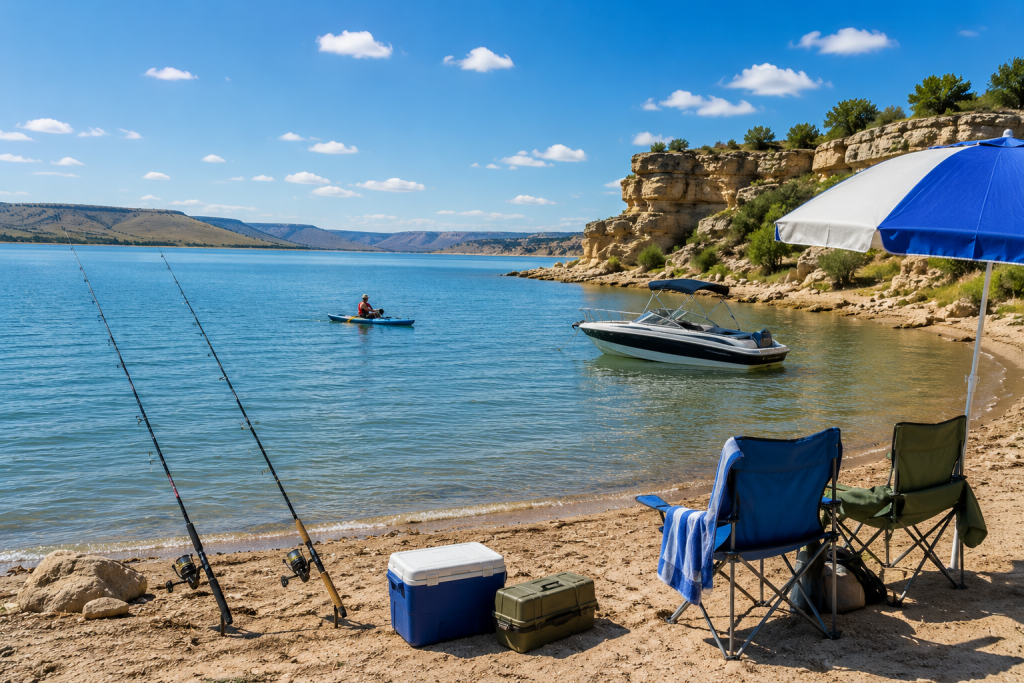
Lake Sakakawea is one of the largest reservoirs in the United States — 178 miles long, covering 307,000 acres when full pool, and extending through the Missouri River corridor all the way up into McKenzie County where the upper arms reach toward Watford City. The lake is effectively the Bakken’s backyard water resource, and the summer fishing and boating calendar around it runs from ice-out in April through October. Here is what a July day trip from Watford City actually looks like.
The scale of Lake Sakakawea surprises people who haven’t been on it. Looking at a map, it’s obviously large. Standing at the water’s edge at Four Bears Bridge or at the Lewis and Clark State Park launch, watching the water extend to the visible horizon in multiple directions with the Missouri Breaks terrain on the far shore as the backdrop, is a different kind of scale than the map suggests. It’s not a lake in the way most Midwestern visitors are used to the word — it’s an inland sea on the Northern Plains, and it fishes like one.
From Watford City, the closest lake access is to the McKenzie County arms of the reservoir — the upper end of the lake where the Missouri River and the Little Missouri River flow in from the west and north. This section of the reservoir is the most immediately accessible from Watford City and is where the day-trip fishing and recreation calendar for the area concentrates.
The Lake Sakakawea Fishery: What Watford City Visitors Are Chasing
Lake Sakakawea has one of the more productive walleye fisheries in the United States — a reputation that draws out-of-state anglers specifically and that the North Dakota Game and Fish Department actively monitors and manages. The walleye population in Sakakawea has fluctuated with drought-related water level changes in recent decades, but the lake consistently produces quality walleye fishing for anglers who understand where to look and how the fish relate to the reservoir’s structure across different seasons.
Walleye: The Target Species
In July, walleye on Lake Sakakawea have completed their spring spawning and post-spawn recovery period and are in their summer distribution patterns — typically relating to the thermocline, deeper structure, and channel edge areas that give them access to forage while staying in the temperature comfort zone they prefer (60-70 degrees F). July walleye on Sakakawea are caught by anglers fishing deeper than spring depths — vertically jigging in the 20-to-35-foot range over rock piles, channel edges, and submerged points, or trolling crankbaits and spinners along depth contours in the 15-to-25-foot range. Live minnows on a bottom-bouncer rig fished along the break lines between shallow flats and deeper channel is the persistent producing technique that never really goes out of season on this lake regardless of what the trend presentations are doing.
Northern Pike and Smallmouth Bass
Northern pike are present throughout the reservoir and reach impressive sizes in Lake Sakakawea — 30-inch-plus fish are not unusual, and the upper arms of the lake near the Missouri and Little Missouri River inflows produce pike that have the specific aggressive summer feeding behavior that makes them accessible even during midday hours when walleye have moved deeper. Large spinnerbaits and in-line spinners worked through submerged timber and vegetation in the upper lake arms are the summer pike presentation that produces on this section of Sakakawea. Smallmouth bass — a species established in the rocky shoreline sections — are a summer light-tackle target that anglers specifically travel to the lake for in July and August.
“Lake Sakakawea in July is a morning and evening walleye lake and an all-day pike lake. The anglers who figure out the combination of both species across the same day come back to camp with a story. The ones who only chase walleye in the midday heat come back frustrated.”
Access Points From the Watford City Area
The McKenzie County section of Lake Sakakawea — the upper end of the reservoir closest to Watford City — has several access points within reasonable day-trip range.
Four Bears Bridge Area
The Four Bears Bridge on US-23, approximately 25 miles south of Watford City, crosses the Missouri River arm of Lake Sakakawea and provides access to both shores in this section. The Four Bears Marina and adjacent area have historically provided boat launch access and marina services; confirming current operational status and launch fee structure before the trip is advisable. The bridge area is the most accessible lake viewpoint and fishing access point from the Watford City direction, and the character of the lake in this section — the Missouri River arm with the Garrison Buttes terrain visible to the south — is impressive even from the bridge itself.
Lewis and Clark State Park
Lewis and Clark State Park on Lake Sakakawea is approximately 20 miles south of Watford City on ND-1806, in the Stanton area of Mercer County. The park has a boat launch, campground, swimming beach, and picnic facilities — making it the most complete developed public access point to the lake from the Watford City area. Day use at the park requires a current North Dakota state parks vehicle permit or a per-day entrance fee; the boat launch requires a separate boat ramp sticker for North Dakota residents. Current permit fees and hours at parkrec.nd.gov. Lewis and Clark State Park is the most family-complete day-trip destination in the Sakakawea corridor from Watford City — the swimming beach in particular makes it the right choice for groups who want water access for non-anglers alongside the fishing.
New Town and Four Bears Area
The New Town area on the Fort Berthold Indian Reservation, about 30 to 35 miles south of Watford City on US-23, has additional lake access including the boat ramp at Four Bears Casino and Lodge. The Four Bears Casino marina has historically provided launch access and boat services; confirm current access arrangements directly before planning a launch at this location. Note that fishing in designated tribal waters on the Fort Berthold Reservation may require a tribal permit from the Mandan, Hidatsa, and Arikara Nation (Three Affiliated Tribes) in addition to a North Dakota state license.
Swimming and Cool-Off Shores
Lake Sakakawea’s surface water temperature in July reaches the mid-70s to low 80s degrees F in the shallow bays and coves — warm enough for swimming that is genuinely comfortable, especially by North Dakota standards. The deep open-water sections maintain a thermocline that drops temperature rapidly below the surface layer, but the shallow bays in the upper arms of the lake near Watford City heat up enough through July for extended swimming.
Lewis and Clark State Park has the designated swimming beach with the best-developed facilities for families — a roped beach area, nearby restrooms, and park infrastructure that makes a family swimming day manageable. The Four Bears Bridge area’s accessible shoreline is an informal swimming option used by locals, particularly in the early morning and evening. Swimming in undesignated areas at a reservoir of this scale carries the same considerations as any Great Plains reservoir — no lifeguard, no designated facilities, and depth transitions that develop quickly from the bank edge.
What to Bring: The July Sakakawea Packing List
The wind is the variable that most Sakakawea first-timers underestimate. The Northern Plains wind patterns that move across open prairies can produce whitecap conditions on the reservoir’s open water with relatively little warning — conditions appropriate for larger motorized boats are not appropriate for small aluminum boats or kayaks in the exposed main lake sections. Checking the NOAA Point Forecast specific to Lake Sakakawea before any boating day gives more relevant guidance than the general Watford City land forecast, because the lake’s open water creates local wind amplification the land-based forecast doesn’t fully capture.
Beyond weather awareness: SPF 50 sunscreen applied before departure and brought for reapplication. Insulated water bottles. Electrolyte supplements for a full day on the water — July heat in the upper 80s to low 90s F on the open lake, with wind’s cooling effect masking cumulative sun exposure. Life jackets for every person on the boat, legally required. A fish cleaning kit if walleye is on the dinner menu — the drive back from Sakakawea to Watford City with a cooler of fresh walleye is one of the better July Bakken evening experiences available.
Lake Sakakawea day trip from Watford City — quick reference: Lake stats: 307,000 acres at full pool, 178 miles long. Third-largest US reservoir by surface area. Garrison Dam, completed 1953. Primary species: walleye, northern pike, smallmouth bass, white bass, channel catfish. July walleye: 20-35 ft depth, vertical jig or bottom-bouncer rig along break lines. Morning and evening peak activity. Access: Four Bears Bridge/US-23 (~25 mi south) | Lewis and Clark State Park/ND-1806 (~20 mi south) | New Town/Four Bears (~30-35 mi south). Swimming: Lewis and Clark State Park designated beach — day use fee, parkrec.nd.gov. Best family option. Tribal waters note: fishing near Fort Berthold Indian Reservation waters may require MHA Nation tribal permit in addition to ND state license. Confirm before fishing. Wind: check NOAA Point Forecast for Sakakawea conditions, not just Watford City forecast. License: North Dakota fishing license required for anglers 16+. ndgfd.nd.gov.
For oilfield workers and long-term Watford City residents who want to use Lake Sakakawea across multiple off-rotation days, the oilfield worker housing at Watford City RV Park covers the base-camp logistics. Extended visitors making the most of the Bakken summer can check the monthly RV sites in Watford City. Visitors approaching from the Sidney, Montana corridor can check the RV park near Sidney, MT page. And for planning any summer Watford City stay with Sakakawea access in mind, Watford City RV Park is the starting point.
Frequently Asked Questions
How far is Lake Sakakawea from Watford City, ND?
The closest Lake Sakakawea access to Watford City is at the Four Bears Bridge on US-23, approximately 25 miles south of Watford City — a drive of 25 to 35 minutes. Lewis and Clark State Park on ND-1806 is approximately 20 miles south by the most direct route. The Four Bears Casino and Marina area near New Town is approximately 30 to 35 miles south on US-23 — the furthest of the three main access points but with additional marina infrastructure. All three are within comfortable day-trip range from Watford City RV Park for a morning fishing launch.
What fish can you catch in Lake Sakakawea in July?
Lake Sakakawea produces walleye, northern pike, smallmouth bass, white bass, channel catfish, and freshwater drum throughout summer. Walleye is the primary target — in July they’re at 20 to 35-foot depths, most accessible by vertical jigging over structure or trolling crankbaits along depth contours. Northern pike in the upper lake arms are accessible with large spinnerbaits in shallower timber and vegetation zones throughout the day. Smallmouth bass along rocky shoreline sections are a July light-tackle specialty. All anglers 16 and older require a valid North Dakota fishing license, available at ndgfd.nd.gov or from licensed retailers in the Watford City area.
Is there a swimming beach on Lake Sakakawea near Watford City?
Lewis and Clark State Park on Lake Sakakawea, approximately 20 miles south of Watford City on ND-1806, has a designated swimming beach with a roped swimming area, restroom facilities, and park infrastructure that makes family swimming days manageable. Day use at the park requires a current North Dakota state parks vehicle permit or per-day entrance fee — current fee schedules at parkrec.nd.gov. The park’s swimming beach is the most developed and family-appropriate swimming option within day-trip range of Watford City. Informal shoreline swimming is possible at various other access points but without facilities or lifeguard services.
How large is Lake Sakakawea?
Lake Sakakawea is the third-largest reservoir in the United States by surface area — 307,000 acres (roughly 480 square miles) at full pool, stretching 178 miles along the Missouri River corridor from Garrison Dam in McLean County through McKenzie County in the upper reaches near Watford City. The lake was created by the construction of Garrison Dam, completed in 1953 as part of the Pick-Sloan Missouri Basin Program. At its maximum depth, the lake reaches approximately 180 feet near the dam. The open-water sections produce wind and wave conditions that require attention from boaters in a way that smaller Midwest reservoirs don’t.
Do I need a North Dakota fishing license to fish Lake Sakakawea?
Yes. All anglers 16 and older fishing in North Dakota waters require a valid North Dakota fishing license. Non-resident licenses are available through the North Dakota Game and Fish Department at ndgfd.nd.gov or from licensed retail vendors in the Watford City area. Note that portions of Lake Sakakawea’s shoreline and certain access points are within the Fort Berthold Indian Reservation, and tribal fishing regulations from the Mandan, Hidatsa, and Arikara Nation (MHA Nation) may require a tribal permit in addition to the state license for fishing in designated tribal waters. Confirming the specific access point’s jurisdictional status before fishing avoids compliance issues that can result in significant fines.
Is boating safe on Lake Sakakawea in July?
Boating on Lake Sakakawea in July is safe with appropriate preparation — and that preparation specifically includes weather awareness beyond the general land forecast. The lake’s 178-mile length and open-water exposure amplify wind-driven wave conditions that develop faster than the Watford City area forecast suggests. Checking NOAA’s Point Forecast specific to the Lake Sakakawea area before any boating day, staying near sheltered bays in uncertain weather, and departing open water before afternoon wind development peaks is the standard approach for experienced Sakakawea boaters. Life jackets for every person on the boat are legally required and are the safety device that matters most on a reservoir where wave heights can reach 3 to 4 feet in afternoon wind conditions.