

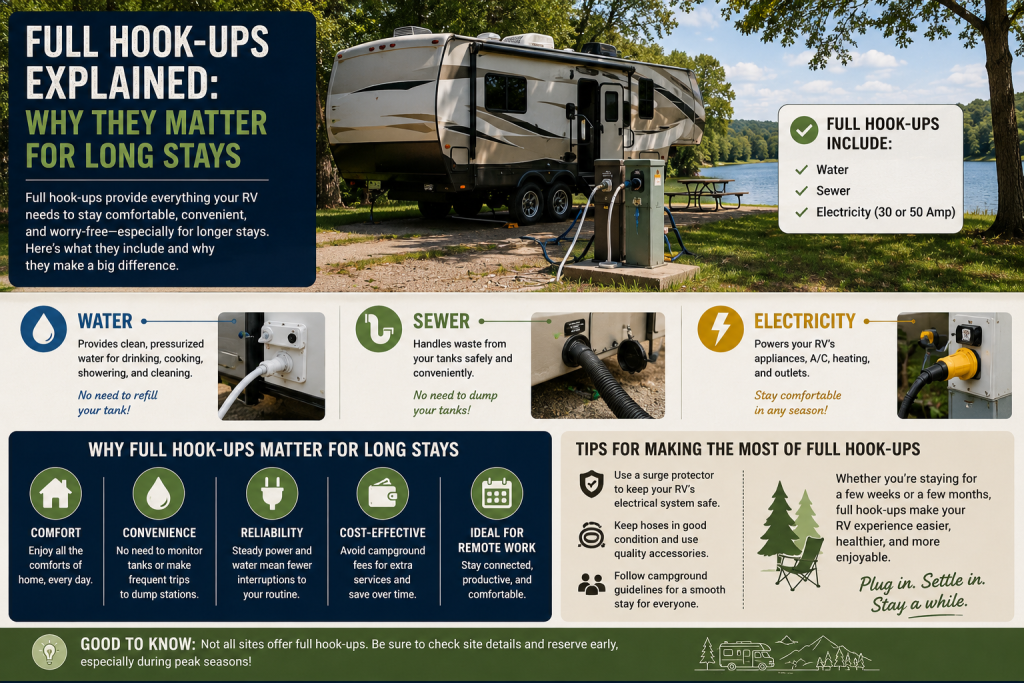
If you’re new to RV living — or you’ve only ever done weekend campouts — “full hookups” might sound like a minor upgrade. After about a week in a rig without them, you understand exactly why they aren’t.
The difference between a full hookup site and a partial hookup site matters a lot more over days and weeks than it does over a single weekend. Short stays are forgiving — you can manage tanks, conserve water, and use the campground bathrooms without it affecting your overall experience much. Extend that stay to two weeks, a month, or several months, and the equation changes completely.
This guide breaks down what full hookups actually consist of, why each component matters, and why the distinction between full and partial hookups is one of the most important site selection factors for anyone planning an extended RV stay — whether you’re a full-time traveler, a snowbird, or an oilfield worker using an RV as your long-term Bakken home base.
The Three Components of Full Hookups
A full hookup RV site provides three connections at the pedestal: electrical, water, and sewer. Each one does something distinct, and the absence of any one of them changes what daily RV life looks like in a specific and significant way.
Electrical: 30-Amp vs. 50-Amp
Electrical hookup is the component most RVers understand first because it’s the most analogous to home electrical service. A standard 30-amp hookup provides 120 volts through a 30-amp service — roughly 3,600 watts of continuous capacity. That’s enough for one air conditioning unit, a basic appliance load, and standard lighting, but it can be limiting in modern larger rigs that run multiple rooftop AC units, electric cooktops, or high-draw appliances simultaneously.
A 50-amp RV site is genuinely different — not just “more amps” but a different service configuration. A 50-amp RV hookup is actually a 120/240-volt split-phase service that provides two 50-amp legs, giving a total capacity of approximately 12,000 watts. For large Class A motorhomes, fifth wheels with dual AC systems, or any rig with significant electrical demands (electric heating, residential refrigerators, washer/dryer units), the 50-amp service is the minimum that prevents the kind of load management juggling that gets old fast on a long stay.
Most established full-hookup parks offer both 30-amp and 50-amp pedestals. Always know which service your rig requires and confirm that the site you’re booking provides it. Adapters (50-amp to 30-amp) exist for when you need to use a 30-amp service temporarily, but they limit your available load — a large rig on a 30-amp adapter can’t run all its systems simultaneously.
Water: The Direct Connection
The water hookup connects your rig’s fresh water system directly to the park’s water supply, eliminating the need to monitor and manage a freshwater tank. This sounds like a convenience rather than a necessity on a weekend, but over weeks and months it’s genuinely different from how water management works in a tank-dependent setup.
With a direct water hookup, you shower without calculating the tank impact. You do laundry. You run the dishwasher. You water consumption patterns look like a household rather than a camping trip. Without a water hookup, every gallon that enters your tanks has to be monitored and every gallon that leaves has to be managed — a discipline that’s sustainable for a trip but draining over an extended stay.
The water connection requires a few basic items: a potable water hose (blue or white — food-grade, never a garden hose), a water pressure regulator rated to protect your rig’s plumbing (most RV systems are designed for 40-60 PSI; municipal water pressure can exceed this and damage fixtures and connections), and a filter if water quality is a concern. In North Dakota and similar regions, a quality inline water filter is a reasonable investment given that rural municipal water systems can have mineral content that affects taste and appliance longevity.
Winter adds a critical component: a heated water hose. In temperatures below 32°F, an unheated hose will freeze and rupture. North Dakota winters — where temperatures regularly drop below -20°F in January and February — make a quality heated water hose with continuous thermostat protection not optional but essential. This is the single most commonly underprepared item among first-time Bakken winter RV residents.
Sewer: The Component That Changes Everything
The sewer connection is the hookup component that most meaningfully distinguishes extended-stay RV living from temporary camping, and it’s the one that new RVers most consistently underestimate until they’re managing tanks on a long stay.
Without a sewer hookup, both your gray tank (sinks and shower drain) and your black tank (toilet) need to be monitored and dumped regularly. A standard gray tank runs 30-50 gallons; a black tank runs 30-40 gallons. On a long stay with normal household water usage, gray tanks fill in two to three days and black tanks in three to five. Dumping requires either driving to a dump station or calling a pump service — neither is a major hardship on a short trip, but it becomes a genuinely disruptive maintenance chore over months.
A direct sewer connection eliminates this entirely. Your waste drains continuously, your tanks never fill, and your daily life doesn’t include a dump-station calculation. This is the full hookup component that full-time RVers most consistently cite as quality-of-life essential on extended stays.
“Three weeks into a long stay without a sewer hookup, every experienced full-timer says the same thing: I should have found a full hookup site from the start.”
The Long-Stay Calculation: Why Full Hookups Pay for Themselves
Full hookup sites typically cost more per night than partial hookup or no-hookup sites. Over a short stay, the premium is easy to notice and hard to justify if you’re trying to minimize costs. Over a long stay, the calculation reverses.
Partial hookup sites that don’t include sewer require paid dump station visits or pump service calls — typically $20 to $50 per dump in the Bakken region, every few days. Over a month, that adds $100 to $400 to the effective cost of a “cheaper” site. The water usage management discipline of a tank-dependent setup adds friction to daily life that has a real quality-of-life cost even without a direct dollar amount. And the electrical constraints of a 30-amp service on a 50-amp rig add appliance management stress that compounds over weeks.
The full hookup premium, spread over a monthly rate, usually amounts to a modest incremental cost that is fully recovered in dump fees, reduced friction, and the simple fact that your RV home functions like a home rather than like a campsite you’re managing carefully.
Full Hookups for Oilfield Workers: The Specific Case
For Bakken oilfield workers using RV living as their primary housing during rotation assignments, the full hookup question has a particular answer that’s worth stating directly: full hookups aren’t optional for a functional long-term work housing situation.
The recovery quality you get from your off-rotation time directly affects your on-rotation performance. Coming home from a 12-hour shift to a rig where you’re managing tanks, running generators to compensate for inadequate electrical service, or dealing with frozen connections in -20°F weather is a preventable quality-of-life failure that compounds over a rotation cycle. A proper full hookup site — 50-amp service, direct water, continuous sewer — means your home base functions reliably and you don’t spend your recovery hours doing infrastructure maintenance.
The oilfield worker housing at Watford City RV Park is specifically built around this understanding. The monthly full hookup sites in Watford City provide the infrastructure that makes extended work stays genuinely sustainable rather than just technically possible. For workers and travelers in the Sidney, Montana corridor on the Montana side of the Bakken, the RV park near Sidney, MT gives nearby options worth knowing. And for everything about the park and its full hookup infrastructure, Watford City RV Park is the starting point.
Full hookup quick-reference for long stays: Electrical: Know whether your rig needs 30-amp or 50-amp service — confirm before booking. Large rigs with multiple ACs or high-draw appliances need 50-amp. Adapters work temporarily but limit capacity. Water: Bring a food-grade white or blue hose, a pressure regulator (40–60 PSI rated), and an inline filter. In winter at the Bakken, a heated thermostat-controlled water hose is mandatory. Sewer: For stays longer than a week, continuous sewer connection is quality-of-life essential. Without it, plan on a tank dump every 2–5 days depending on usage and tank capacity.
Frequently Asked Questions
What does a full hookup RV site include?
A full hookup RV site includes three utility connections at the site pedestal: electrical service (30-amp, 50-amp, or both), a fresh water connection, and a sewer connection. These three connections allow the RV to operate as a self-contained home without tank management — fresh water runs continuously from the park supply, waste drains continuously to the sewer, and electrical service runs all systems at the rig’s normal operating capacity. Sites with only one or two of these connections are partial hookup or “electric and water only” sites, which require active tank management for any sewer-producing activities.
What is the difference between 30-amp and 50-amp RV service?
A 30-amp service is a single 120-volt, 30-amp circuit providing approximately 3,600 watts of capacity. A 50-amp service is a 120/240-volt split-phase circuit with two 50-amp legs, providing approximately 12,000 watts of total capacity. The practical difference is what you can run simultaneously: a 30-amp service handles one AC unit and basic appliances, while a 50-amp service handles dual AC units, residential refrigerators, washer/dryer combos, and other high-draw appliances simultaneously. Most modern Class A motorhomes and larger fifth wheels are factory-wired for 50-amp service. Confirming that your rig’s service requirements match the site’s available service before booking prevents undersupply issues on arrival.
Do I need a water pressure regulator for hookup connections?
Yes. A water pressure regulator is essential equipment for any water hookup connection. RV plumbing systems are designed for 40 to 60 PSI — municipal water supply can reach 80 to 100 PSI or higher, and that pressure applied directly to an RV’s plumbing can damage pipes, connections, and fixtures. A basic inline water pressure regulator (under $20 at any RV supply retailer) connects between the campground supply and your water hose and reduces pressure to a safe range. This is a one-time $20 investment that protects significantly more expensive plumbing from a preventable failure mode.
How important is a sewer hookup for a two-week stay?
Very. At normal household water usage, a gray tank (30-50 gallons) fills in 2-3 days and a black tank (30-40 gallons) fills in 3-5 days. For a two-week stay, that means 4-7 dump station visits for gray water alone, plus 2-4 for black water. Dump station visits cost $20-$50 each in many Bakken area locations. Beyond the cost, the time and planning involved in regular tank management adds friction to the stay that wears on most people beyond the one-week mark. A full hookup site with continuous sewer eliminates this entirely — a genuine quality-of-life improvement rather than just a convenience on stays of this length.
What do I need for a water hookup in a North Dakota winter?
Winter water hookup in North Dakota requires a heated water hose — standard unheated hoses freeze and rupture in temperatures below 32°F, and North Dakota regularly reaches -20°F or colder in January and February. A quality heated water hose with a built-in thermostat activates heating automatically when temperatures approach freezing. Look for hoses with fully enclosed heating element construction (not just a wrap-around heating cable), rated to temperatures well below zero. Additionally, the rig’s underbelly should be properly insulated or skirted to protect the water line from the connection point to where it enters the rig — even a short uninsulated section can freeze at the Bakken’s winter lows.
Can I leave my sewer connection open all the time on full hookups?
For gray water (sinks and shower), leaving the valve open continuously is common practice on full hookups — this allows continuous drainage without black water management concerns. For black water, the standard guidance is to keep the valve closed until the tank is at least two-thirds full before dumping. Leaving the black tank valve open continuously allows liquid to drain while solids accumulate without sufficient liquid to carry them, creating a buildup issue that requires tank flushing to resolve. The gray valve open, black valve managed approach is the standard full hookup practice that balances continuous drainage convenience with appropriate tank maintenance.