

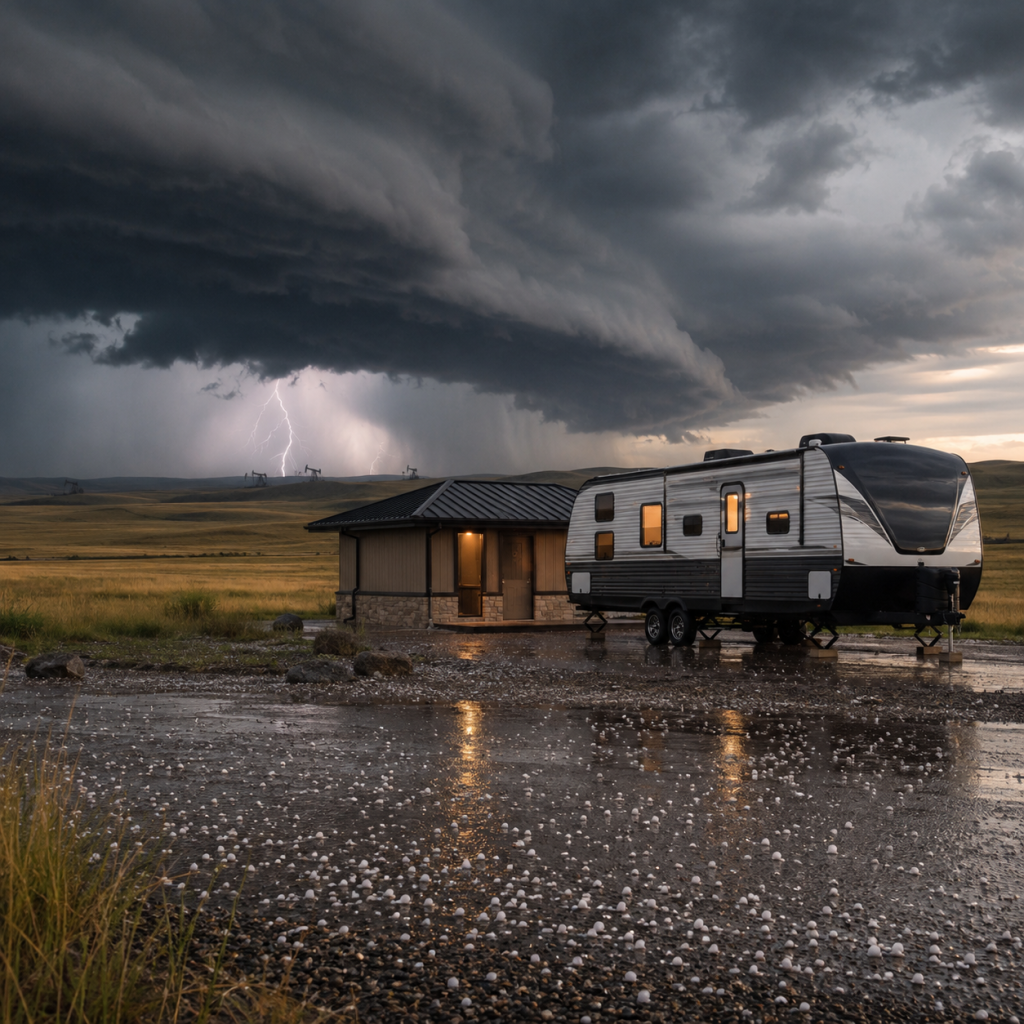
The same open terrain that gives the Bakken its enormous sky and dramatic sunsets also gives its summer thunderstorms room to build fast and hit hard. Lightning and hail are both genuine, regular features of a North Dakota summer, and understanding how they behave on this specific landscape — and what that means for an RV specifically — is essential information for anyone spending a season in Watford City, not just a nice-to-know.
Read this first. This post provides general safety education. It does not replace real-time monitoring of the National Weather Service (weather.gov) and local McKenzie County emergency alerts, which should always be your primary source during any active weather event. If a severe thunderstorm or tornado warning is issued, take shelter immediately in the safest available location — don’t wait to visually confirm the threat.
The Northern Plains produce some of the most visually dramatic summer storms in the country — towering supercells visible for fifty miles across open prairie, the kind of sky that photographers specifically chase. That same visibility is also a warning sign worth taking seriously: when you can watch a storm build from a great distance on the Bakken’s open terrain, it means the storm itself has the room and the atmospheric setup to become genuinely severe.
Why the Open Prairie Produces Such Intense Storms
The Bakken region sits within a broader area of the Northern Plains where warm, moist air moving up from the south regularly collides with cooler, drier air from the north and west, particularly during summer afternoons when daytime heating adds additional energy to the atmosphere. This collision is the basic engine behind severe thunderstorm development, and the open, largely flat terrain around Watford City doesn’t provide the kind of topographic disruption that can weaken storm development the way mountainous terrain elsewhere sometimes does.
The result is a summer storm season that regularly produces large hail, damaging straight-line winds, and — while less frequent than in the traditional Tornado Alley states further south — genuine tornado risk as well. The National Weather Service’s Bismarck office covers the Watford City and McKenzie County area, issuing severe thunderstorm and tornado watches and warnings specific to this region during active weather.
Lightning Safety on Open Terrain
Lightning risk on the open Bakken prairie carries a specific additional consideration beyond the general lightning safety principles that apply anywhere: there’s often very little natural shelter available if you’re caught outside when a storm develops. No forest canopy, no urban structures nearby, often not even significant terrain relief to break up the exposure. This makes indoor shelter — and specifically, knowing where that shelter actually is before you need it — more important here than in many other regions.
The 30-30 Rule Still Applies
The standard lightning safety guideline holds regardless of terrain: if the time between seeing a lightning flash and hearing the resulting thunder is 30 seconds or less, the storm is within roughly 6 miles and close enough to pose genuine risk — seek shelter immediately. Wait at least 30 minutes after the last audible thunderclap before resuming outdoor activity, since lightning can strike from a storm cell that appears to have moved past.
RV-Specific Lightning Considerations
A hard-sided RV with a metal frame provides a degree of protection during a lightning event, similar to the “cage” effect of a metal-roofed vehicle, provided you avoid touching the RV’s metal frame, plumbing fixtures, or plugged-in electrical devices during an active strike nearby. This is meaningfully better protection than being outside or in a tent, though it doesn’t match the protection of a permanent, properly grounded building. During active lightning, staying inside, disconnecting from shore power if a storm is actively approaching, and avoiding plumbing use are all reasonable additional precautions.
“You can watch a Bakken storm build for twenty minutes before it actually gets to you out here, which sounds like plenty of warning — and it usually is, if you’re actually watching. The people who get caught off guard are the ones who saw the storm building and kept doing what they were doing anyway.”
Hail: The Underrated Bakken Summer Hazard
Large hail is a genuine and specific risk in North Dakota summer storms, and it’s a hazard that RVers sometimes underestimate relative to wind and lightning. Severe thunderstorms in this region can produce hail from pea-sized up through golf ball, baseball, or occasionally larger stones, and hail at the larger end of that range can cause real damage to an RV’s roof, awning, windows, and exterior panels — damage that’s considerably more expensive and disruptive to deal with than most people expect until it happens to their own rig.
Protecting Your RV From Hail
The most effective hail protection is simply not being outside with your awning deployed when a hail-producing storm arrives — retracting the awning at the first sign of developing severe weather protects it from the specific kind of puncturing and tearing damage that hail causes to awning fabric. If advance warning allows, moving your vehicle under any available covered parking or substantial overhead structure reduces roof and windshield exposure, though this obviously depends on what’s actually available at your specific site.
For RVs, there’s no practical way to “hail-proof” the roof itself beyond the structure’s existing construction, which makes advance warning and timing — knowing a storm is coming before the hail actually starts falling — the most practical protective measure available. This is another reason why active weather monitoring during the Bakken summer storm season matters more than it might in a region with less severe hail risk.
Building a Storm Season Routine
A few practices make Bakken summer storm season meaningfully more manageable. Check the forecast each morning during storm season, and specifically check again in the early-to-mid afternoon before any outdoor plans, since Northern Plains storms frequently develop in the afternoon and evening hours as daytime heating builds atmospheric instability. Download a weather alert app or keep a NOAA Weather Radio active, particularly overnight, since severe storms don’t limit themselves to daylight hours and an overnight warning requires a way to actually wake you up.
Know your specific RV park’s designated shelter location before you need it — ask at check-in rather than assuming any particular building qualifies, and physically locate it so you’re not searching for it during an active warning. If you’re staying at Watford City RV Park through the peak of summer storm season, this is worth confirming early in your stay rather than waiting until a warning is already active.
For guests managing both the heat and storm sides of a Bakken summer, the Bakken heat and wind RV tips guide covers the broader summer weather management picture, including the same awning retraction habit that protects against both wind damage and hail — one good practice doing double duty for two different hazards.
Bakken summer storm safety — quick reference: Why storms are intense: open terrain + warm/moist air colliding with cooler dry air, no topographic disruption to weaken development. NWS Bismarck covers Watford City/McKenzie County. Lightning: 30-30 rule applies (30 sec flash-to-thunder = shelter now; wait 30 min after last thunder). RV offers meaningful but not complete protection — avoid touching metal frame/plumbing/plugged-in devices during a strike. Hail: pea-sized to golf-ball or larger. Retract awning at first sign of severe weather. No way to hail-proof a roof — advance warning and timing are the real protection. Daily routine: check forecast morning and again mid-afternoon (Northern Plains storms build with daytime heating). Weather alert app/NOAA radio active overnight. Know your shelter: confirm your RV park’s designated shelter location at check-in, physically locate it before you need it. Official sources: weather.gov (NWS Bismarck), McKenzie County emergency management.
For guests planning an extended Bakken summer stay through storm season, the oilfield worker housing at Watford City RV Park covers the base-camp logistics for a longer stay. Monthly-rate guests can check the monthly RV sites in Watford City for extended summer stay options. Visitors approaching from the Glendive, Montana corridor to the west can check the RV park near Glendive, MT page. And for booking any Bakken summer stay with storm season awareness in mind, Watford City RV Park is the starting point — ask about the property’s severe weather shelter plan when you book.
Frequently Asked Questions
Why are Bakken summer storms so intense?
The Bakken region sits in an area where warm, moist air from the south regularly collides with cooler, drier air moving in from the north and west, particularly during summer afternoons when daytime heating adds energy to the atmosphere. This collision is the basic engine behind severe thunderstorm development, and the open, largely flat terrain around Watford City doesn’t provide the topographic disruption that can weaken storm development in more mountainous regions. This combination regularly produces large hail, damaging straight-line winds, and genuine tornado risk, making severe weather awareness an important part of any Bakken summer stay.
Is it safe to stay in an RV during a lightning storm in North Dakota?
A hard-sided RV with metal frame construction provides meaningful protection during a lightning event, similar to the protective effect of a metal-roofed vehicle, provided you avoid touching the RV’s metal frame, plumbing fixtures, or plugged-in electrical devices during an active strike nearby. This is significantly safer than being outside or in a tent, though it doesn’t match the protection of a permanent, properly grounded building. Staying inside, disconnecting from shore power if a storm is actively approaching, and avoiding plumbing use during active overhead lightning are all reasonable additional precautions specific to RV occupants.
How can I protect my RV from hail damage in the Bakken?
The most effective protection is retracting your awning at the first sign of developing severe weather, since hail causes significant puncturing and tearing damage to awning fabric that’s avoidable if the awning isn’t deployed when hail arrives. If advance warning allows, moving your vehicle under any available covered parking reduces roof and windshield exposure, though this depends on what’s actually available at your specific site. There’s no practical way to fully hail-proof an RV’s roof beyond its existing construction, which makes active weather monitoring and advance timing the most important protective measures — knowing a storm is approaching before hail actually starts falling.
What is the 30-30 rule for lightning safety?
The 30-30 rule states that if the time between seeing a lightning flash and hearing the resulting thunder is 30 seconds or less, the storm is within approximately 6 miles and close enough to pose genuine risk, meaning you should seek shelter immediately. After the last audible thunderclap, the rule recommends waiting at least 30 minutes before resuming outdoor activity, since lightning can strike from a storm cell that appears to have already moved past. This guideline applies regardless of terrain and is a practical, easy-to-remember tool for anyone spending time outdoors during Bakken summer storm season.
How big does hail get in North Dakota summer storms?
North Dakota summer thunderstorms can produce hail ranging from pea-sized up through golf ball, baseball, or occasionally larger stones during particularly severe storm events. Hail at the larger end of this range can cause significant damage to an RV’s roof, awning, windows, and exterior panels. The National Weather Service issues severe thunderstorm warnings that specifically note expected hail size when large hail is anticipated, which is useful information for deciding how urgently to protect exposed equipment like an awning before a storm arrives.
How do I find out if my RV park has a storm shelter?
Ask directly at check-in whether your RV park has a designated storm shelter, a sturdy on-site building suitable for severe weather, or a specific plan for notifying guests during active severe weather, and don’t assume any particular structure is automatically a safe shelter without confirming this with the property. Physically locating the shelter early in your stay, rather than waiting until a warning is active, ensures you’re not searching for it under time pressure. This is a reasonable and common question for any RV park in a region with genuine severe storm risk, including the Bakken.