

Most people know Yellowstone. Most people know the Grand Canyon. Far fewer have made the drive to the North Dakota badlands — which is exactly why Theodore Roosevelt National Park still feels like you found something.
There’s a specific quality to the places that haven’t been completely discovered yet — where the parking lot isn’t full by 8 a.m., where the hiking trails don’t require reservations, where the wildlife is genuinely wild because it hasn’t been habituated to constant human presence. Theodore Roosevelt National Park still has that quality. Especially the North Unit.
The park is split into two sections — the South Unit near Medora and the Theodore Roosevelt National Park North Unit near Watford City — and both are extraordinary. But the North Unit in particular has a remoteness and an undervisited character that sets it apart from almost any other national park experience in the lower 48 states. You go for a full day and see more bison, feral horses, and badlands landscape than you’d see in a week at a more popular park.
This guide covers the full Theodore Roosevelt National Park trip planning process — what to see in each unit, when to go, how to do the Maah Daah Hey Trail if that’s on your list, and why the Watford City area is the right home base for a serious park visit.
Understanding the Two Units
The park is technically three units — South, North, and the Elkhorn Ranch Unit, which is a more remote, undeveloped site where Roosevelt’s cattle ranch was located — but most visitors focus on the South and North Units, which have road access, visitor centers, and the infrastructure for a day trip or multi-day exploration.
The South Unit: Near Medora
The South Unit near Medora is the more visited and more accessible of the two main sections. The Painted Canyon Visitor Center off I-94 is often visitors’ first view of the badlands — a dramatic overlook with the canyon spreading below in layers of color that make the typical first reaction something close to disbelief. The South Unit has a 36-mile scenic loop road that can be driven in two to three hours without stops, or expanded to a full day with trail walks and wildlife stops.
Bison are common in the South Unit, often right alongside the road. The prairie dog towns are extensive and entertaining. Longhorn steers — descendants of cattle from the historical ranching period — roam the unit in small herds. The sunset light on the painted buttes in the South Unit is one of the more famous natural photography opportunities in North Dakota.
The North Unit: The One Most People Miss
The North Unit badlands are 70 miles north of the South Unit on US-85, near Watford City. The landscape here is different — more compressed, more dramatic, more genuinely wild-feeling. The Little Missouri River cuts through the unit in broad loops, creating the river bend overlooks that are among the most striking viewpoints in the park system.
The 14-mile scenic drive to the Oxbow Overlook passes through terrain that changes character every mile — grassy flats, badlands buttes, river bottom forest, open prairie ridge. The drive is manageable in two hours without stops and rewarding over a full day with stops. Wildlife in the North Unit is less habituated to visitor presence than in the South Unit — the bison herds here are more likely to be encountered in the open landscape rather than alongside a road, which produces a different and arguably more authentic wildlife experience.
“The North Unit has the quality that the most famous parks had before they became famous. You should go before that changes.”
When to Go: Summer at TRNP
Summer — June through August — is the primary visitor season for Theodore Roosevelt National Park, and the North Dakota summer is genuinely excellent for the park experience. Days are long (sunset around 9:30 p.m. in June), temperatures are warm but typically not extreme, and the park’s wildlife is highly active.
Summer does bring specific considerations. The badlands heat up significantly in midday — afternoon temperatures in July can reach 95 to 100°F in the exposed terrain. Wildlife activity is concentrated in the early morning and evening hours when the temperature is manageable. Planning your driving and hiking for before 10 a.m. and after 5 p.m. and finding shade or AC during the midday hours is the experienced summer visitor’s approach.
Mosquitoes are active in the river bottom areas and lower terrain through July and early August. DEET repellent is not optional for evening wildlife walks in these areas. The higher badlands terrain has less mosquito pressure, but the river bottom woodland where many of the most rewarding wildlife encounters happen requires preparation.
Late August through September is arguably the best combined timing — still warm, significantly fewer visitors than peak July, and the beginning of fall color changes in the cottonwood stands along the river.
The Maah Daah Hey Trail
The Maah Daah Hey Trail is a 144-mile non-motorized trail that connects the North Unit and South Unit of Theodore Roosevelt National Park through the badlands of the Little Missouri National Grassland. It’s one of the most distinctive long-distance trails in the American interior — alternating between dramatic badlands buttes, open prairie ridge walks, and river bottom woodland crossings in a landscape that looks like no trail in the Appalachians or the Rockies.
For through-hikers, the trail is a multi-week undertaking with backcountry camping at designated sites along the route. But the trail is also accessible for day hikes from multiple trailheads — sections of the Maah Daah Hey near the North Unit are accessible for one to four hour walks that give a genuine taste of the trail’s character without a full multi-day commitment.
Mountain biking is permitted on most sections of the trail, and the Maah Daah Hey has developed a significant following in the mountain biking community as one of the most scenic and technically interesting long-distance routes in the Midwest. Riders typically take three to five days to complete the full trail, using supported camping or logistics services to carry gear.
Wildlife: What You’ll See and When
The wildlife picture at Theodore Roosevelt National Park is one of the more compelling in the national park system. The combination of species, accessibility, and relative lack of crowds produces encounters that are more intimate than in heavily visited parks.
Bison are the dominant species and are present in both units year-round in substantial numbers. The bison here are genuinely large animals — adult bulls weighing 1,800 to 2,000 pounds — and they exist in their natural social structure, which means you may encounter solitary bulls, mixed herds, or cow-calf groups depending on the time of year and the season. Summer brings calves, which are present from late May through July and add to the herd dynamics.
Feral horses — not “wild” in the technically accurate sense, but descendants of escaped domestic horses and managed as a natural feature of the park — roam both units in small bands. The North Unit horses are particularly photogenic against the badlands landscape. Prairie dogs are ubiquitous in the grassland areas. Pronghorn are frequently seen in the open prairie sections. Elk are present, particularly in the North Unit, though less frequently encountered than bison.
Your Base Camp: Watford City and the North Unit
For visitors who want to fully explore the North Unit and use the park as the center of their trip rather than a side excursion, Watford City is the right base. The North Unit entrance is less than 20 miles from town on US-85 — close enough for an early morning drive to catch the dawn light over the river bends, and close enough to return for dinner and be back the next morning without losing half the day to driving.
Summer North Unit day trip from Watford City: Leave by 6:30 a.m. for the golden hour light on the badlands terrain. Drive the 14-mile scenic road to Oxbow Overlook — this takes 2-3 hours with stops and wildlife watching. Walk the Caprock Coulee Nature Trail (4.4 miles round trip) if the temperature is manageable by the time you finish the drive. Return to town for midday. Afternoon: The Maah Daah Hey trailhead near the park for a short section hike in the late afternoon cool. Evening: Return to the park for the sunset hour, when wildlife activity picks back up and the light on the buttes is at its best. The whole day is a full North Unit experience without being rushed.
For RV park near Theodore Roosevelt National Park options, Watford City RV Park is the established home base for park visitors — close to the North Unit, full hookups, and the infrastructure that makes multi-night park stays comfortable rather than logistically challenging. For travelers whose route takes them through the New Town and Fort Berthold area, the RV park near New Town, ND is another option worth knowing about in the region.
For workers who are in the area for the Bakken oilfield and want to combine work housing with park access, the oilfield worker housing in Watford City information covers the extended-stay options, and the monthly RV sites in Watford City give the specifics for longer-term stays that make regular park visits possible throughout the summer season.
Frequently Asked Questions
How far apart are the North and South Units of Theodore Roosevelt National Park?
The South Unit near Medora and the North Unit near Watford City are approximately 70 miles apart on US-85, with a drive time of roughly 1 to 1.25 hours. Most visitors who are making a dedicated park trip visit both units on separate days rather than trying to do both in a single day trip. Each unit warrants at least a full day for a proper visit. Visitors based in Watford City are ideally positioned for the North Unit; the South Unit is a reasonable day trip but doesn’t benefit from the same proximity.
Do I need a reservation to visit Theodore Roosevelt National Park?
As of current park policy, Theodore Roosevelt National Park does not require timed entry reservations, which distinguishes it from more heavily visited national parks that have implemented reservation systems in recent years. A standard National Park entrance fee applies (covered by the America the Beautiful annual pass). Campground reservations for the park’s campgrounds are recommended for summer weekends and should be made through recreation.gov well in advance. Day visitors without camping plans can arrive without advance reservation, though this is worth confirming on the park’s NPS website before your trip as policies can change.
What wildlife is most likely to be seen at the North Unit?
Bison are the most reliable large wildlife encounter at the North Unit, present year-round and typically visible from the scenic drive. Feral horse bands are regularly seen in the badlands terrain and are one of the more distinctive wildlife features of the North Unit. Prairie dogs are numerous in the grassland areas. Pronghorn are frequently seen in open terrain. Elk are present in the North Unit in greater numbers than the South Unit and are most visible in the early morning and evening hours near river bottom areas. White-tailed deer and mule deer are common throughout the park. Bighorn sheep were reintroduced and can be seen in the rugged badlands terrain.
What is the Maah Daah Hey Trail and can I do part of it on a day trip?
The Maah Daah Hey Trail is a 144-mile non-motorized trail connecting the North and South Units of Theodore Roosevelt National Park through the Little Missouri National Grassland. The full trail is a multi-day undertaking (typically 10-14 days for hikers, 3-5 days for mountain bikers). Day hike access is available at multiple trailheads, including sections near the North Unit that offer one to four hour walks through genuine badlands terrain without requiring overnight logistics. The NPS and Dakota Prairie Grasslands websites have current trailhead information and access conditions.
What should I pack for a summer day at Theodore Roosevelt National Park?
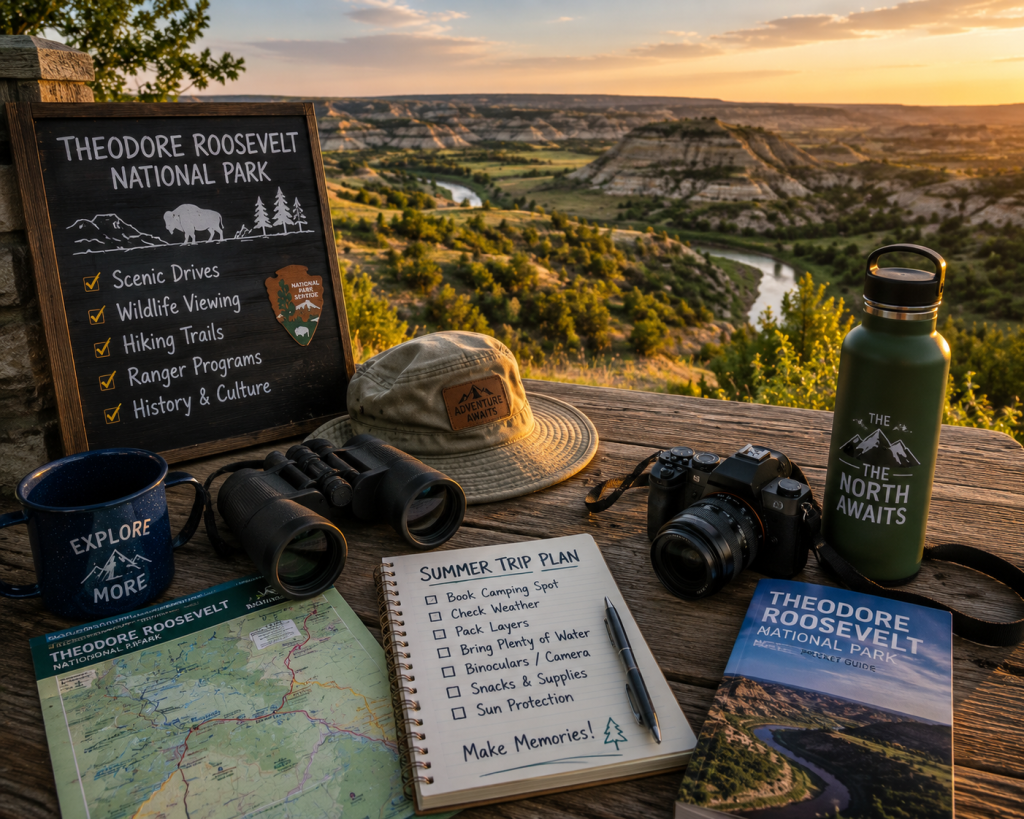
Water is the most critical item — the badlands terrain has essentially no shade and the summer heat in exposed areas can be extreme. Bring significantly more water than you think you need (minimum 2 liters per person for a day hike). Sunscreen and a hat are non-optional. DEET insect repellent for the river bottom areas in morning and evening. A camera with some reach (200mm or more equivalent lens) benefits enormously from the wildlife encounters — bison, horses, and prairie dogs are highly photogenic but at distances where a phone camera will produce disappointing results. Binoculars for the scenic drive viewpoints. Closed-toe shoes for any trail walking. A light layer for the early morning, which can be significantly cooler than the afternoon even in July.
Is Theodore Roosevelt National Park good for children?
Yes, with appropriate planning for the summer heat. The wildlife viewing is exceptional for children — bison close to the road, prairie dog towns that are endlessly entertaining for younger visitors, and the horses are a particular hit. The Junior Ranger program at both visitor centers gives kids an engaged framework for the visit. Trail hiking in summer should be planned for the early morning when temperatures are manageable; the scenic drives are fully accessible for children who aren’t yet up for extended hiking. Bringing ample water and sun protection, and building in a midday break during the hottest hours, makes the summer visit comfortable for families with young children.